Stop Chasing Case Updates: The Complete Guide to Law Firm Operational Visibility
If you want to stop chasing case updates, the fix isn't a faster follow-up habit. It's removing the reason anyone has to chase in the first place: work that only shows its status when someone stops to ask. Most firms don't have a workload problem. They have a workflow problem that looks like one, and the first place it shows up is case status nobody can find without interrupting someone.
This guide pulls together what we've written about that problem from every angle, ownership, intake, paralegal turnover, partner blind spots, and lays out what operational visibility actually means as a category, not just a nicer dashboard.
Jump to a Section
- What "operational visibility" actually means
- The real cost of "who's handling this?"
- What real-time visibility looks like, day to day
- What breaks when the one person who knows is out
- Visibility starts before the case even opens
- What partners miss without it
- Practical takeaways
- Frequently asked questions
What "Operational Visibility" Actually Means
Operational visibility isn't more reporting. A report tells you what already happened. Visibility tells you what's happening right now, whether a matter is moving, stalled, or waiting on someone, without anyone having to go look.
That distinction matters because most firms already have a system that looks like it should answer this. It doesn't, and it was never built to. Your case management system is the record. It stores documents, dates, contacts, and billing. It does not tell you whether the draft sitting in it has actually been reviewed, or whether it's been sitting untouched for four days. Case management and workflow management solve two different problems, and firms that only have the first one are missing the second entirely. The same confusion shows up when people compare legal project management to workflow management, which is really a paralegal's guide to the difference between case management and project management worth reading if your firm uses those terms interchangeably.
Legalboards' own framing for this is blunt: your case management system is the rearview mirror, showing you what already happened. Operational visibility is the windshield. One is a record. The other shows you what's moving right now, what's stalled, and who owns the next step, without a meeting, an email, or a follow-up call. For the full breakdown of what that looks like in practice, Legalboards' own guide to law firm operational visibility covers the diagnostic signs and what to do about them in more depth than we will here.
The Real Cost of "Who's Handling This?"
Count how many times a day someone at your firm asks who's handling something. That question isn't small talk. It's the most expensive question a law firm asks itself, because every time it gets asked, it means ownership was assumed instead of assigned, and the assumption just turned out to be wrong.
The cost isn't the thirty seconds it takes to answer. It's the interruption to whoever answers, the delay while the actual task waits, and the fact that this repeats for different tasks, multiple times a day, across every matter the firm is running. That's the coordination problem most firms don't realize they have until someone actually counts it across a week instead of treating each instance as a one-off.
The fix isn't a meeting to clarify ownership after the fact. It's making ownership visible before the question ever needs to get asked. What that actually looks like when every task has exactly one clear owner is worth reading if your firm is still assigning work by whoever's loudest or most available in the moment. Workflow automation is what makes that ownership stick without someone manually reassigning it every time a matter moves, which is a related but separate problem worth its own read if you haven't looked at how workflow automation works for law firms.
What Real-Time Visibility Looks Like, Day to Day
Visibility isn't a dashboard you check once a week. It's the ability to open a board and see, right now, what's in intake, what's stalled in review, and what's about to become a deadline problem, without asking anyone. Real-time case visibility at a 10-to-50-person firm looks different than it does at a five-person shop or a 200-person practice, mostly because this is exactly the size range where informal coordination stops working but nobody's built the replacement yet.
The clearest symptom of missing this is a recurring status meeting. If your firm has a standing Monday check-in whose entire purpose is finding out where things stand, that meeting is doing the job your system should be doing on its own. The Monday status meeting your firm shouldn't need is a good gut check for whether your visibility problem has become so normal nobody questions it anymore.
Real-time visibility also isn't the same as reporting speed. A faster weekly report is still a report, generated after the fact, about work that already happened. What actually changes coordination is why real-time collaboration matters more than real-time reporting, because collaboration means the people working the matter can see and act on the same information at the same time, not just read about it later.
What Breaks When the One Person Who Knows Is Out
Every firm has a version of this: one paralegal who's been with an attorney for years, who knows which clients want proactive updates and which files need a call before anything goes out. When that person takes two weeks off, the deadlines don't break. They live on a calendar. What breaks is everything underneath them, the context that was never written down because nobody ever had to write it down while she was there to supply it on demand. What actually breaks when your most experienced paralegal takes time off walks through exactly what that gap costs, and it's rarely the deadline itself.
This cuts the other way too. The paralegals carrying that institutional memory are often the ones closest to burning out, precisely because the firm runs fine on the surface while quietly depending on everything they hold in their heads. Why the best paralegals burn out at firms that run fine is worth reading alongside the coverage problem, because they're the same structural gap wearing two different faces.
New paralegals feel the inverse version of it. Without visible workflow, new hires slow a firm down for months, not weeks, because there's no written version of "how things work here" for them to learn from, only whoever's willing to explain it out loud, repeatedly. That's why new paralegals keep asking what to do next long after they should have picked it up on their own. None of this is a training failure. It's a visibility failure that training can't fix, because the thing missing was never written down for anyone to learn.
Visibility Starts Before the Case Even Opens
Most firms think about operational visibility as a problem inside open matters. It actually starts earlier than that, in the gap between first contact and signed retainer, before a case has a matter number at all. A lead can sit for days simply because no one explicitly owns the next step, and your law firm can lose clients before you've ever met them without a single person doing anything wrong.
Firms lose cases before the consultation even happens for the same reason work stalls anywhere else: the handoff between "someone should follow up" and "someone did follow up" isn't visible to anyone but the person sitting on it. Why client intake stalls when no one owns the next step breaks down exactly where those handoffs fail, usually between four or five people who each assume someone else already handled it.
The pattern shows up so consistently that it's worth naming directly: a firm's own intake process is often what's quietly losing its new clients, not the quality of the consultation or the fee structure. Fixing it isn't about moving faster. It's about making every handoff visible enough that nothing sits untouched by accident.
What Partners Miss Without It
Partners tend to find out about a problem when a client calls or a deadline gets missed, which means they're managing reactively by default. What partners don't see when their firm has no workflow structure is usually everything happening between the stages they do track: the draft that's finished but unreviewed, the matter that's been sitting untouched for a week, the associate who's quietly overloaded while another has room to take on more.
Visibility changes what partners can see about the firm as a system, not just individual matters. It shows up in smaller ways too, like how case tracking actually improves client communication, because a client update grounded in real matter status lands differently than one pieced together from memory before the call. And it shows up in resourcing decisions: partners and office managers who can see workload across the whole team are the ones equipped to work through resource allocation hurdles before someone is quietly buried while someone else has capacity to spare.
See How This Works in Legalboards
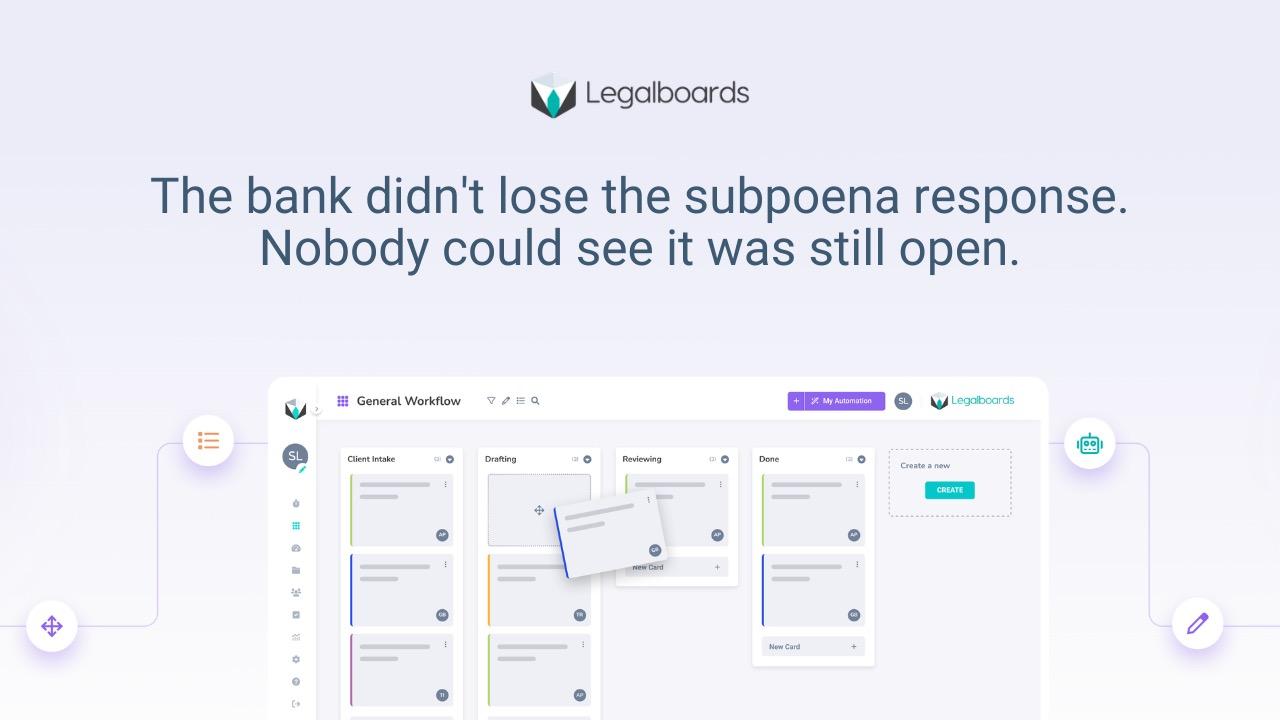
Everything above describes the same underlying gap from different angles: ownership, coverage, intake, partner blind spots. The fix in each case is the same, making status visible by default instead of something someone has to go find. See how this works in Legalboards to see the actual mechanics: stage-based boards, automatic stall flags, and workload views built for exactly the problems this guide walks through.
Practical Takeaways
- If you're asking "where are we on this" more than once a week, that's not an effort problem, it's a system that isn't answering on its own.
- Ownership has to be a name, not a group. A task without a specific owner defaults to whoever's loudest or most available, and that doesn't hold up across a full caseload.
- Visibility has to start at first contact, not case opening. Intake is where firms lose the most work invisibly, because nobody's tracking a lead the way they track an open matter.
- Coverage gaps aren't a staffing problem. They're a sign that matter context lives in one person's memory instead of somewhere anyone covering can see.
- A case management system and a workflow layer do different jobs. One is the record. The other shows you whether the work is actually moving.
Frequently Asked Questions
How is operational visibility different from the reports my case management system already generates?
Reports summarize what already happened, usually after someone requests one. Operational visibility shows what's happening right now: which matters are moving, which are stalled, and who owns the next step, without anyone generating or requesting anything.
What's the first sign my firm has a visibility problem instead of a workload problem?
If your team is busy but deadlines still feel closer than they should, that's usually visibility, not effort. The work is moving, but nobody can see how close it actually is to the edge until it's urgent.
Do I have to replace Clio, MyCase, or PracticePanther to get this?
No. Operational visibility is a layer that sits on top of your case management system, not a replacement for it. Your matter records, billing, and documents stay where they are. The workflow layer adds stage tracking, ownership, and stall detection on top.
Can I tell how long a matter has been sitting in one stage?
Yes, that's one of the core mechanics behind real operational visibility. Stage duration gets tracked automatically, with thresholds you set, so a matter that's stalled gets flagged before it becomes a deadline problem instead of after.
Does adopting this mean retraining my whole team?
Not if it's built into how people already work. The structural pieces, stages, ownership, triggers, are what create visibility. The day-to-day experience for staff should stay simple.
For more on the diagnostic signs and what to do about them, see the full breakdown on operational visibility.