
It's 8 PM, and she's still at her desk working through emails and follow-ups that should've ended hours ago. She has years at the firm and is good at the job. This is paralegal burnout at a law firm that, on paper, runs fine.
Why Do Good Paralegals Burn Out Even at Firms That Run Fine?
Good paralegals burn out at firms that run fine because nobody is failing in an obvious way. Deadlines mostly get hit. No partner is yelling about a missed filing. And the paralegal is still depleted.
The cause is not workload by itself. It is that she has become the place where everyone's different way of working gets reconciled. She is not just running the casework. She is running a constant translation layer that nobody scoped, named, or staffed for.
This is not a paralegal who can't keep up or a new hire still learning the ropes. It is an experienced, competent person absorbing a job that was never written down anywhere.
The Hidden Job: Translating Each Lawyer's Preferences
Here is what that translation layer looks like in practice. One attorney wants a status update by email, every time. Another wants a Slack message, and gets annoyed by email. A third never asks for an update at all. He expects the paralegal to simply know a task is done, because he mentioned it once in passing on his way to court.
Status translation is the unscoped work of converting one piece of case progress into whatever format, channel, and timing each individual lawyer expects. It does not show up on an org chart. It is not in any job description. It is also not optional, because if she gets it wrong, the lawyer assumes the work itself is behind.
A nine-attorney family law firm illustrates the pattern well. The paralegal supporting four of those attorneys tracks, in her head, which one wants a Friday email recap, which one wants a same-day Slack ping, and which one wants nothing unless something goes wrong. None of that is casework. All of it is required to do the casework without friction.
The paralegal is not doing one job. She is doing the actual legal support work, plus a second job of remembering and reproducing five different communication preferences, with no formal recognition that the second job exists.
Why This Doesn't Show Up as a Problem Until Someone Leaves
Each interaction is small. A two-line Slack update here, a quick email there. None of it looks like a structural issue, because none of it is unreasonable on its own.
That is exactly why it compounds invisibly. The cost does not show up in any report a firm normally watches: billables, matter counts, deadline compliance. It shows up as fatigue the paralegal absorbs quietly, often for years, until she does not.
The Clio Legal Trends Report has repeatedly flagged non-billable administrative drag, not raw caseload, as one of the most underestimated costs at small firms. Status translation is exactly that kind of cost.
When a tenured paralegal finally quits, the firm reads it as a hiring problem. Replace her, post the job, move on. That diagnosis misses the cause, so the next hire inherits the same unscoped translation layer and the cycle repeats.
The burnout is invisible until it becomes a resignation. By then, it gets misread as a people problem instead of the structural gap that actually caused it.
What Office Managers and Partners Should Build Instead
The fix is not asking five lawyers to standardize their personalities. That will not happen, and it should not be the plan.
The fix is giving each matter a next step and an owner that is visible on its own, independent of any lawyer's habits. If status lives on the case instead of in someone's inbox preferences, the paralegal stops being the interface between five different working styles.
This is operational visibility: seeing where a matter stands without asking a person. A few things change once visibility lives on the matter instead of in a person's head:
- A lawyer can check status himself, without needing his preferred channel honored every time.
- The paralegal stops being asked to "just remember" who wants what, because the next step is visible to everyone.
- Coverage gets easier, since a colleague covering for her can see ownership without a handoff conversation first.
This is a different pattern than the one new hires face. A new paralegal still learning where things live is a ramp-up problem. A tenured paralegal absorbing five lawyers' worth of preference-tracking is a structural one. Related, but not the same fix.
The goal is not changing how lawyers communicate. It is making ownership and next steps visible somewhere that does not depend on any one lawyer's habits.
How Legalboards Removes the Translation Layer
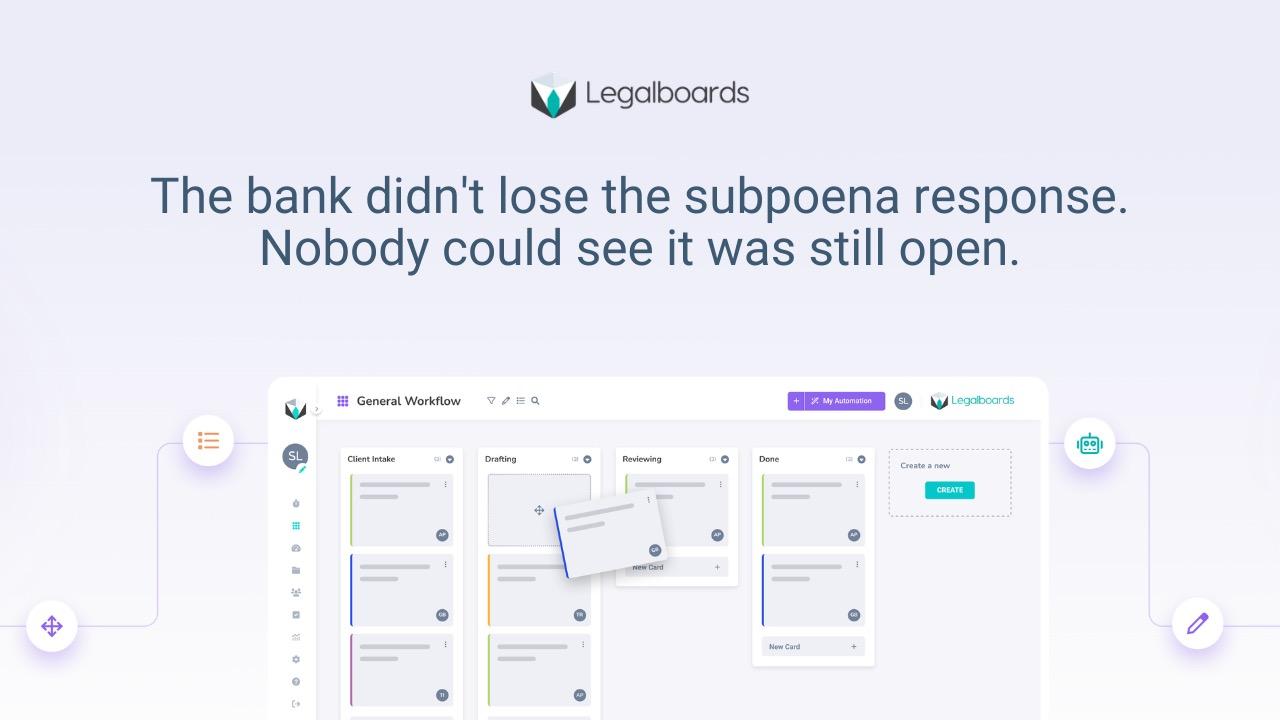
With Legalboards, task ownership and the next step on a matter live on the case itself, not in any one lawyer's head or inbox habits. A paralegal supporting five attorneys with five different styles can look at one board and see who owns what, without needing each lawyer to report status the way she expects it.
Clio still holds the matter file. Legalboards shows how the work is actually moving and whose task it is right now, so operational visibility does not depend on whoever happens to update her first. That difference matters more for paralegals than almost any other role in the firm, because they are the ones absorbing the gap today.
Frequently asked questions
Why do experienced paralegals burn out even at well-run firms?
Because the firm running fine on the surface (deadlines hit, no obvious chaos) hides a separate, unscoped job: translating each lawyer's communication preferences into one consistent stream of status updates. That work is real, constant, and invisible to everyone except the person doing it.
Is this a staffing problem or a workflow problem?
It looks like a staffing problem once someone quits, but it is a workflow problem. The firm does not lack capable people. It lacks a way to make case status visible that does not depend on each lawyer's individual habits, which forces one person to bridge the gap manually.
How do inconsistent lawyer communication styles affect paralegal workload?
Every lawyer who expects a different update format, channel, or timing adds a small but constant task that sits outside the actual casework. Across four or five attorneys, that adds up to a second, unrecognized job layered on top of the real one.
What should a firm fix first to reduce this kind of burnout?
Start by making next-step ownership visible on the matter itself, independent of any lawyer's preferred channel. Once status does not require a particular format to be understood, the paralegal stops carrying the translation work alone.
Does Legalboards change how lawyers communicate, or work around it?
It works around it. Legalboards does not ask lawyers to standardize how they prefer updates. It puts ownership and the next step on the matter so anyone, including the lawyer, can check status without requiring it to come through a specific channel.
That is also a related but different pattern than firms with simply too many open matters. The fix is structural either way: make the work visible on the case, not dependent on memory or habit. If your best paralegals are quietly running this translation layer right now, see how Legalboards makes ownership visible on every matter.