What It Actually Looks Like When Every Task Has One Clear Owner
One owner per task sounds obvious. Most firms do not actually run this way, even when they believe they do. Responsibility tracking law firm teams describe in interviews rarely matches what happens day to day, where two people are half-assigned to something and neither is fully accountable for it.
The Rule Most Firms Break Without Noticing
A task with two people assigned has zero owners. That is not a technicality. When responsibility is shared without being split into specific pieces, each person can reasonably assume the other has it covered, and both can be technically correct that they never explicitly agreed to drop it.
A task with no visible owner is worse. It defaults to whoever notices it first, which is not a system, it is luck. Some weeks that works out. Other weeks it means a task sits untouched until a client asks about it or a deadline arrives. This is the flip side of why "who's handling this" is the most expensive question in your law firm, which looks at the cost of the ambiguity this section is describing the fix for.
The rule is simple to state and harder to enforce without a visible system: every task gets exactly one name attached, and reassignment is a deliberate, visible action, not a hallway conversation that only the two people involved know happened.
What Changes When Ownership Is Visible
Nobody has to ask. That is the practical, immediate difference. A partner checking on a matter can see who has the next action without pulling a paralegal off their own work to answer a question that should already have an answer.
Handoffs become explicit. A task moves from a paralegal to an attorney as a visible action in the system, not an assumption based on "I think Sarah's on it now." That matters most exactly when it is easiest to get wrong, during a busy week when everyone is juggling more than usual. This is the piece of the workflow paralegals tend to feel most directly, since they are usually the ones absorbing the confusion when a handoff isn't explicit. The same handoff discipline is what separates case management from workflow management, a distinction that gets confused often but matters a great deal in practice.
Work stops getting done twice, and stops going undone, because the ambiguity that causes both outcomes is removed at the source. Nobody is guessing whether they should pick something up, because the system already tells them whether it is theirs.
How This Plays Out Across a Full Caseload
The value of single ownership compounds with volume. On one matter, a shared or unclear task might cost a few minutes of confusion. Across fifty open matters, that same pattern repeated dozens of times a week adds up to hours of interruption, duplicated effort, and dropped work that nobody notices until a client or a deadline surfaces it.
This is also where what partners often miss about law firm workflow structure becomes relevant. Partners tend to see the output, whether a matter closed on time and on budget, without seeing the dozens of small ownership gaps that made getting there harder than it needed to be. Making ownership visible does not just fix individual tasks, it gives partners a way to see the pattern before it becomes a client-facing problem.
How to Set This Up
Start by giving every open task exactly one name, not a team, not a role, a specific person. If a task genuinely needs input from two people, split it into two tasks with two distinct owners rather than leaving one task shared.
Make reassignment visible. When ownership changes, that change should be recorded somewhere the rest of the team can see, not communicated only to the person picking it up. This is what prevents the "I thought you had it" gap from reopening a week later.
Surface stalled tasks automatically. A task with no movement in several days should flag itself instead of waiting for someone to notice it has gone quiet. This catches the cases where an owner is assigned but has quietly deprioritized something without telling anyone.
What Resistance to This Usually Looks Like
Staff sometimes push back because "everyone already knows who does what." That is often true, until it isn't, usually the week someone is out sick, a new hire joins mid-caseload, or the firm takes on more matters than the informal system was built to handle. Informal ownership tracking works exactly until it doesn't, and it rarely gives warning before it fails.
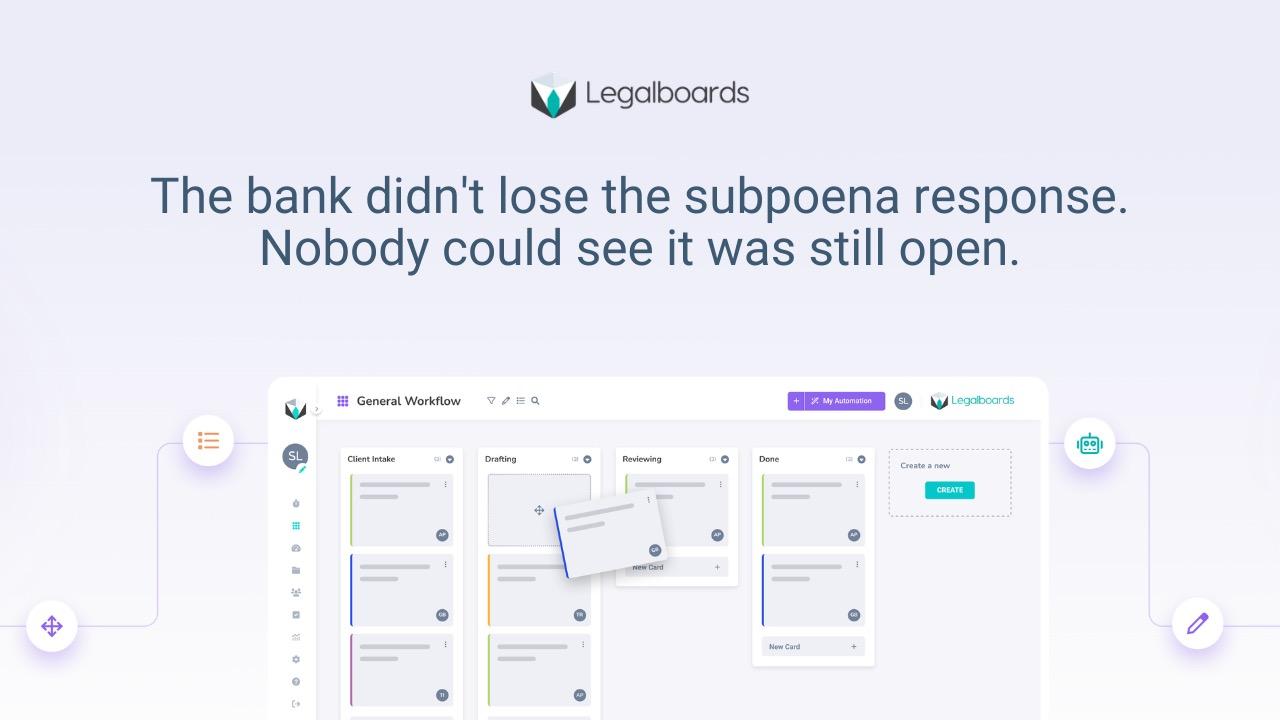
Legalboards makes ownership a visible field on every task, not a note in someone's head, so reassignment and stalled work surface automatically instead of depending on someone remembering to flag it.
Visibility does not replace trust in your team. It removes the guessing that trust gets mistaken for.
Frequently asked questions
Why does shared task ownership cause problems?
When two people are assigned to the same task without a clear split, each can reasonably assume the other is handling it. That ambiguity is what causes tasks to get done twice or not at all.
How do we know if our current system tracks ownership well enough?
If someone regularly has to ask who is handling a specific task, ownership is not actually visible, regardless of what the system claims to track.
Does every task need a single named owner, even small ones?
Yes, for anything that could otherwise stall. Small tasks without a clear owner are often the ones that quietly slip, because nobody notices until a client or deadline surfaces the gap.
What is the difference between assigning a task and tracking ownership?
Assigning a task is a one-time action. Tracking ownership means the assignment stays visible over time, including when it changes, so anyone can see who currently owns a task without asking.
How does Legalboards support clear task ownership?
Legalboards attaches a single owner to each task as a visible field, flags stalled tasks automatically, and records reassignment as a visible action, so ownership never depends on someone remembering to communicate it.
If ownership at your firm still lives in people's heads, see what it looks like when every task has one visible owner → Try Legalboards for free