
Family law discovery rarely stalls because the other side is slow. It stalls because nobody at the firm can see, at a glance, which requests are still open. A family law discovery workflow that lives in email threads and one paralegal's memory will always feel slower than it is, because the delay only shows up when an attorney asks for documents that never arrived.
The bank's pace is out of your control. Not knowing it's late until someone asks is not.
Where family law discovery actually stalls
Picture a divorce file with real assets. In the first month, the firm sends out:
- A request for production to opposing counsel for tax returns, pay stubs and account statements
- Subpoenas to two banks and a brokerage
- A records request to the other spouse's employer for compensation and benefits
- A request to your own client for their statements, which they promised to send "this weekend"
That's six open items on one matter. Each has a different recipient, a different deadline and a different way to follow up. Now multiply that by a paralegal carrying 30 or 40 active files.
None of these requests fail on the day they go out. They fail on day 31, when the response window has closed, nothing has come back, and nobody noticed because nothing on anyone's screen said "overdue."
A bank subpoena, week by week
Week 1. The paralegal drafts and serves the subpoena. The PDF is saved to the matter. The response date goes into her head, or onto a sticky note, or into a calendar entry that just says "Bank?"
Week 2. The client calls, upset about the parenting schedule. Attention moves, as it should.
Week 3. Opposing counsel sends a partial production. It gets saved to the file. Nobody checks it against the original request.
Week 5. The attorney is preparing for a settlement conference and asks for the full financial picture. The bank never responded. The partial production is missing two years of statements. The conference is in nine days.
Nobody did anything wrong in that sequence. Every individual step was handled. What failed was the space between the steps: the request went out, and then it dropped out of view.
That's the pattern behind most law firm coordination problems. Work doesn't usually fail inside a task. It fails between tasks.
Why the gap stays invisible
There are three reasons, and none of them is effort.
Requests aren't treated as work. Sending a subpoena feels like finishing a task. It isn't. The work is done when the documents come back and someone confirms they match what was asked. Most firms track the send and never track the return.
Discovery is spread across people and systems. The request is drafted in Word, served by email or process server, answered by mail or portal, and reviewed by the attorney. No single place shows where all of that stands.
Case management records events, not open loops. Your matter file shows what was filed and received. It doesn't show what's still waiting on someone else. That's the core difference between case management and workflow management.
The result is a paralegal who knows her files well but can't answer "what's outstanding across all of them?" without opening each one. And on the day your most experienced paralegal is out, nobody can answer it at all.
What a tracked family law discovery workflow looks like
Every request becomes its own tracked item, not a line in a note. At minimum, each one carries:
- What was requested, and from whom
- Date sent and response due date
- One owner
- A follow-up date that lands before the due date, not after
- A status
The statuses matter more than they look. A simple set covers most firms:
- Drafting
- Served
- Awaiting response
- Received, under review
- Deficient, follow-up needed
- Complete
Two details make this work in practice.
Partial productions get their own status. A partial response is the most dangerous state in discovery because it looks like progress. If "received" and "complete" are the same box, the missing statements vanish.
Your client's documents go on the same board. In many family law matters, the slowest party is your own client. Treat their outstanding documents exactly like a third-party request: owner, due date, follow-up date.
The follow-up date is the part most firms skip. Knowing the response is due on the 30th doesn't help if nobody looks until the 31st. Good deadline tracking is about the step before the deadline, not the deadline itself.
How to start this week
You don't need new software to test this. You need one honest list.
- Pick your five most active family law matters.
- List every outstanding discovery request, subpoena and client document request on each, with the recipient and due date.
- Assign one owner per request. Not "the team." One person.
- Set a follow-up date five to seven days before each due date.
- Put the list somewhere the attorney can see without asking.
Most firms that do this find at least one request already past due that nobody had flagged. That's not a people problem. It's what happens when work has no visible place to live.
Where Legalboards fits
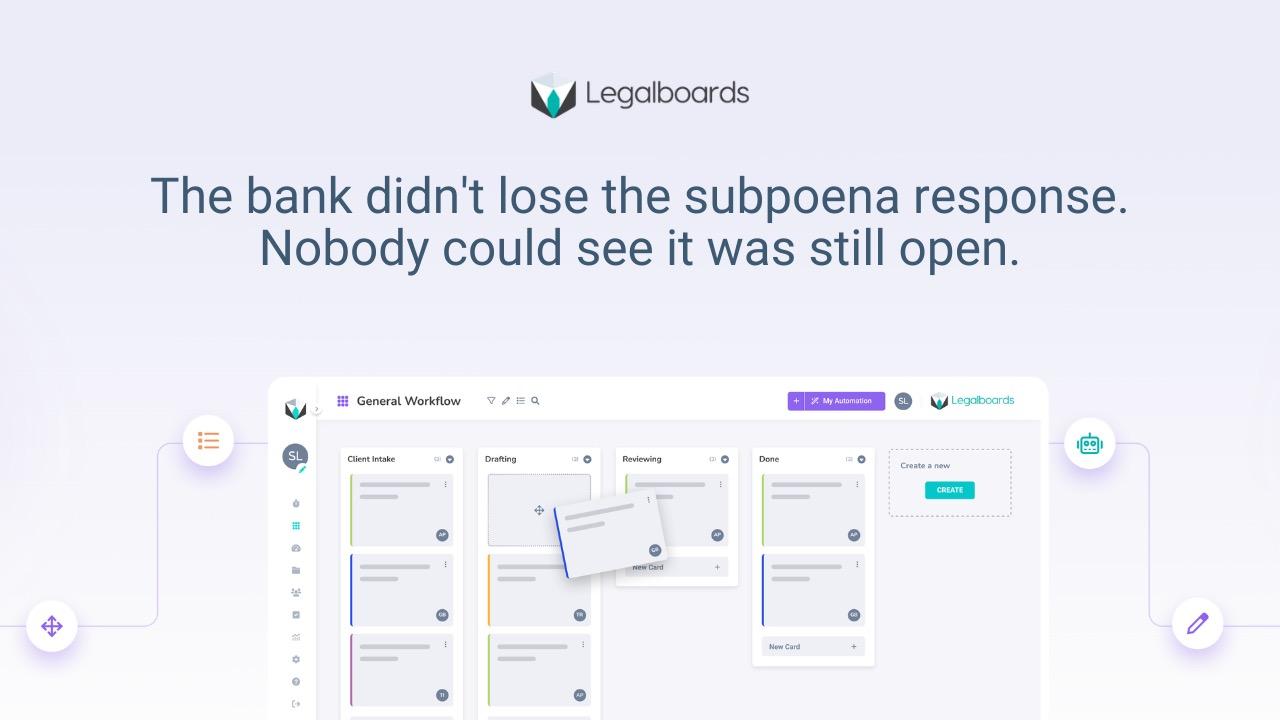
Legalboards runs on top of the case management system you already use, including Clio, MyCase and PracticePanther, and gives discovery its own visible workflow. Each request is a card with an owner and dates. When a card sits in "Awaiting response" too long, an automation can create the follow-up task so nobody has to remember it.
The attorney sees what's outstanding across every matter without interrupting the paralegal to ask. That's what operational visibility means in a family law practice: status you can see, not status you have to chase.
For the full structure of a family law matter from intake to hearing, read how to structure family law workflows or start from the divorce board template. For how other practice areas compare, see law firm workflows by practice area.
Frequently asked questions
What is a family law discovery workflow?
It's the set of stages every discovery request moves through, from drafting to a complete, reviewed response, with one owner and a follow-up date at each step. The point is that anyone at the firm can see which requests are still open without asking the person who sent them.
How long does the other side have to respond to discovery?
It depends on your jurisdiction and the type of request. Many US courts use a 30-day window for written discovery, and Canadian provinces set their own financial disclosure timelines. Check your local rules and put the actual due date on every request, plus a follow-up date before it.
What should a paralegal do when a subpoena response is late?
Follow up the same day the follow-up date hits, not when the attorney asks. Log the follow-up on the request itself so the history is visible. If there's still no response after a second attempt, flag it to the attorney with enough time to consider a motion or another route.
How do you handle a partial production?
Treat it as its own status, separate from complete. Compare what arrived against the original request line by line, list what's missing, and create a follow-up with its own owner and date. A partial production marked "received" is how missing documents get discovered at the worst possible moment.
Does this replace our case management system?
No. Your case management system stays the record of the matter. A workflow layer sits on top of it and shows what's moving, what's waiting, and who owns the next step.
If your team is tracking discovery across inboxes and memory right now, try Legalboards free and put your five busiest family law matters on one board.