
Sarah has been Marco's paralegal for six years, and she is the reason his cases run on time and his Friday filings go out clean. When she took two weeks off, what broke was not a deadline. It was six years of law firm workflow documentation that never existed anywhere except inside her head.
What Actually Breaks When Your Most Experienced Paralegal Is Out
The deadlines did not break. Those live in a calendar, and Daniel, the paralegal covering for Sarah, could see them. What broke was everything underneath the deadlines: the institutional knowledge that explains how a matter or attorney actually works, knowledge that was never written down because nobody ever had to write it down while Sarah was there to supply it on demand.
Daniel was covering two attorneys at once, Marco and his own, and he had no way to know what Sarah knew without asking her directly, which defeated the point of her being out. He did not know which of Marco's clients expect a proactive update every week and which only want to hear from the firm when something changes. He did not know that the Johnson file needs a call before any motion goes out. He did not know what "handle it" meant when Marco said it about three different matters in three different ways.
Why This Is a Workflow Problem, Not a People Problem
Nobody decided that Sarah would become the institutional memory for Marco's practice. It happened gradually, over six years, one preference and one shortcut at a time, because the firm never built a documented alternative to her memory.
That makes this a structural gap, not a performance issue for anyone involved. It is not Sarah's fault that the firm leaned on her. It is not Daniel's fault that he could not reproduce six years of context in two weeks. The firm built its operation on a person instead of a process, and that only becomes visible the moment the person is gone.
This is where operational visibility matters: it means anyone covering a matter can see how it is supposed to move without asking the person who usually runs it. The Clio Legal Trends Report has flagged non-billable coordination work, not raw caseload, as one of the costs small firms consistently underestimate. An undocumented handoff is exactly that kind of cost, just one that stays invisible until someone takes vacation.
What an Undocumented Handoff Actually Costs
None of this shows up cleanly on a P&L, which is why it is easy to ignore until it happens. In practice, it shows up as:
- Coverage stress on whoever is filling in, since Daniel was guessing at preferences instead of doing the actual legal work.
- Attorney frustration when something gets handled in a way that is technically fine but not the way Marco expects.
- Inconsistent client experience during the gap, since clients who expect proactive updates may not get them.
- Mistakes born from not knowing what you don't know, not from carelessness. Daniel could not flag the Johnson file's call-first rule because nobody told him it existed.
- Rework when Sarah returns, since she now has to find and fix whatever went sideways while she was out, on top of catching up on her own matters.
What Firms With Documented Workflows Do Differently
The fix is not a binder of standard operating procedures that nobody opens until something breaks. Firms that handle coverage well do something narrower: they make attorney preferences, client context, and matter-level workflow visible to whoever needs to step in, without that person having to track Sarah down first.
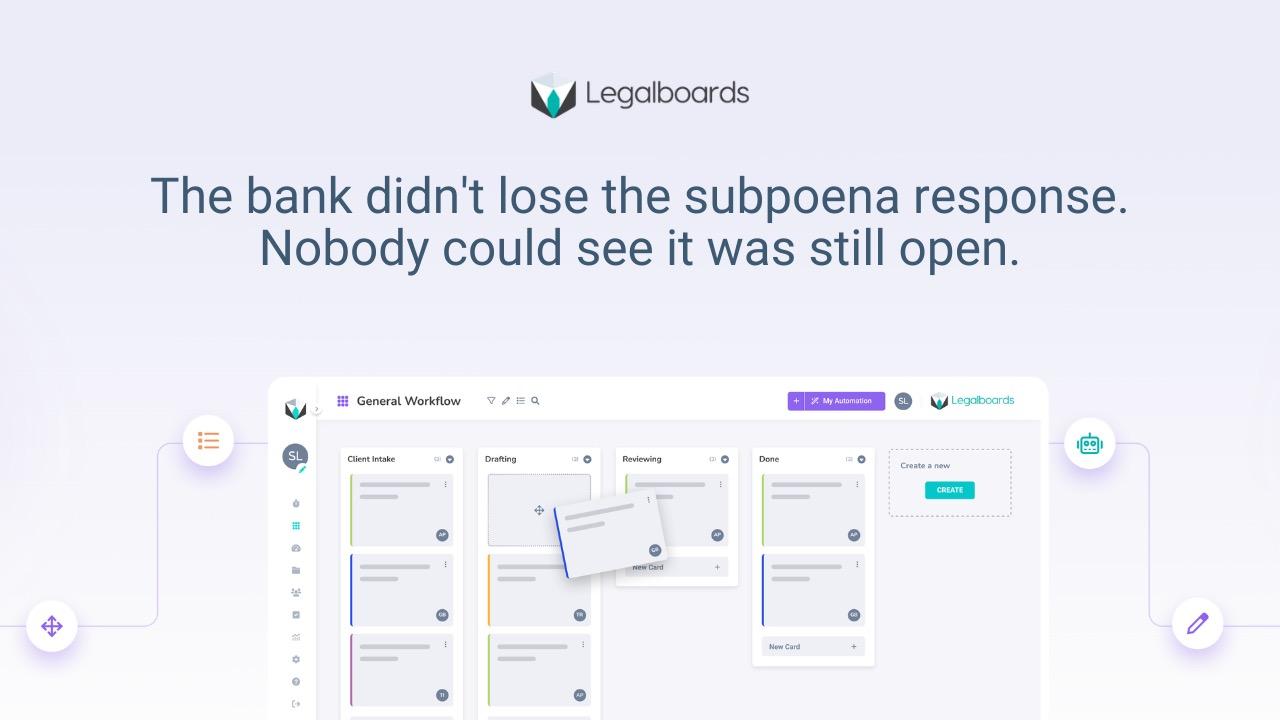
With Legalboards, the next step on Marco's matters lives on the matter itself, not in Sarah's head. If Daniel had been able to open the Johnson file and see "call before motion" sitting next to the task, he would not have needed Sarah's memory to know it. Clio still holds the matter record. Legalboards shows how the work on it is actually supposed to move, which is the layer that was missing when Sarah was out.
This is a coordination problem that firms tend to notice only during a gap, much like a firm whose office manager has to scramble every time someone takes leave. The pattern is the same: work that depends on a person instead of a visible process will always feel like a crisis the moment that person is unavailable. A firm that documented coverage well, like RB Legal LLC, found that the gap stopped feeling like an emergency once matter context stopped living in one inbox.
Frequently asked questions
Why does losing one paralegal for two weeks cause so much disruption?
Because deadlines were never the part that depended on her. The attorney preferences, client expectations, and matter sensitivities she carried in her head were the part with no backup, and those do not show up anywhere a calendar or case file can surface them on their own.
Is this a hiring or staffing problem?
It looks like one when a tenured paralegal is out or eventually leaves, but it is a workflow problem. The firm has capable people. It lacks a place outside one person's memory where matter-level context lives, which is what law firm workflow documentation is supposed to solve.
How is this different from a new hire ramping up?
A new paralegal who keeps asking what to do next is still learning where things live. A tenured paralegal covering for someone equally experienced is missing context that was never written anywhere for anyone to learn. Related problem, different cause.
What should a firm document first to reduce coverage stress?
Start with attorney preferences and matter-specific flags, like which clients want proactive updates or which files need a call before a motion goes out. That is the context a covering paralegal actually needs, not a general procedures manual.
Does this replace the paralegal's judgment?
No. Visible workflow context does not make decisions for anyone. It gives whoever is covering the information they need to use their own judgment correctly, the same way Sarah uses hers because she has it memorized.
How does Legalboards work alongside Clio for this kind of coverage gap?
Clio stores the matter file. Legalboards shows the next step and the context attached to it, so a covering paralegal can see what Sarah would have told them without needing her on the phone during her time off.
If two weeks of coverage feels like a crisis at your firm, the issue is not that Sarah was gone. It is that the workflow only existed when she was in the room. See how Legalboards makes matter context visible to whoever is covering.