
A potential client fills out a contact form on Friday afternoon. By Tuesday, three people have looked at it, none of them followed up, and the lead has called another firm. The paralegal who finds the form Tuesday morning did not drop the ball. There was no clear law firm client intake workflow telling her it was hers to pick up.
Why Do Law Firms Lose Clients During Intake?
Law firms lose clients during intake because no single person owns each step of the process. A lead moves through several hands before a retainer goes out, and if ownership is not assigned at every stage, the lead sits untouched until someone happens to notice it.
It is rarely a speed problem. It is an ownership problem. A 2024 Clio Legal Trends Report found that client intake and lead follow-up remain among the most common sources of lost revenue at small firms, not because firms respond too slowly on purpose, but because no one is explicitly responsible for the response.
Summary: Intake fails when responsibility is implied instead of assigned. Fixing it means naming an owner for every stage, not just speeding up the steps.
Where Intake Actually Breaks Down
Intake at a small firm usually runs through four or five handoffs: someone takes the first contact, someone runs the conflict check, someone sends the fee agreement, someone confirms the signed retainer, someone schedules onboarding. Each handoff is a place the work can stall.
Here is a concrete version of that stall. A prospective client emails the general firm inbox on a Thursday. The office manager forwards it to a paralegal "when she gets a chance." The paralegal assumes the office manager already sent the intake questionnaire. Neither one checks. By Monday, the client has not heard back in four days and has already called a competitor.
Matter stages are the defined steps a case or lead moves through, from first contact to a signed retainer or closed file. Without visible stages, a lead's status lives in someone's memory, not in a system anyone else can check.
A few patterns that make intake worse:
- No single inbox. Leads arrive by phone, web form, referral email, and walk-in, with no shared view of all of them together.
- Assumed ownership. Tasks get mentioned in passing ("can you follow up on that") instead of assigned with a name and a deadline.
- No status visibility. Nobody outside the person handling a lead can see whether it has been contacted, quoted, or signed.
- No SLA. There is no internal standard, like a four-hour callback window, that the team can actually measure against.
Most of these patterns get fixed with workflow automation at the handoff points themselves, not by adding more tasks to anyone's list.
Summary: Intake breaks at the handoffs, not the tasks themselves. Each unassigned handoff is a place a lead can sit untouched for days.
What Office Managers Can Do Differently
Fixing this does not require new software for new software's sake. It requires making the handoffs visible, with a name attached to each one. Clio remains the system of record for the matter once it opens. The gap is upstream of that, in the time between first contact and signed retainer, where there often is not a clear workflow automation step at all.
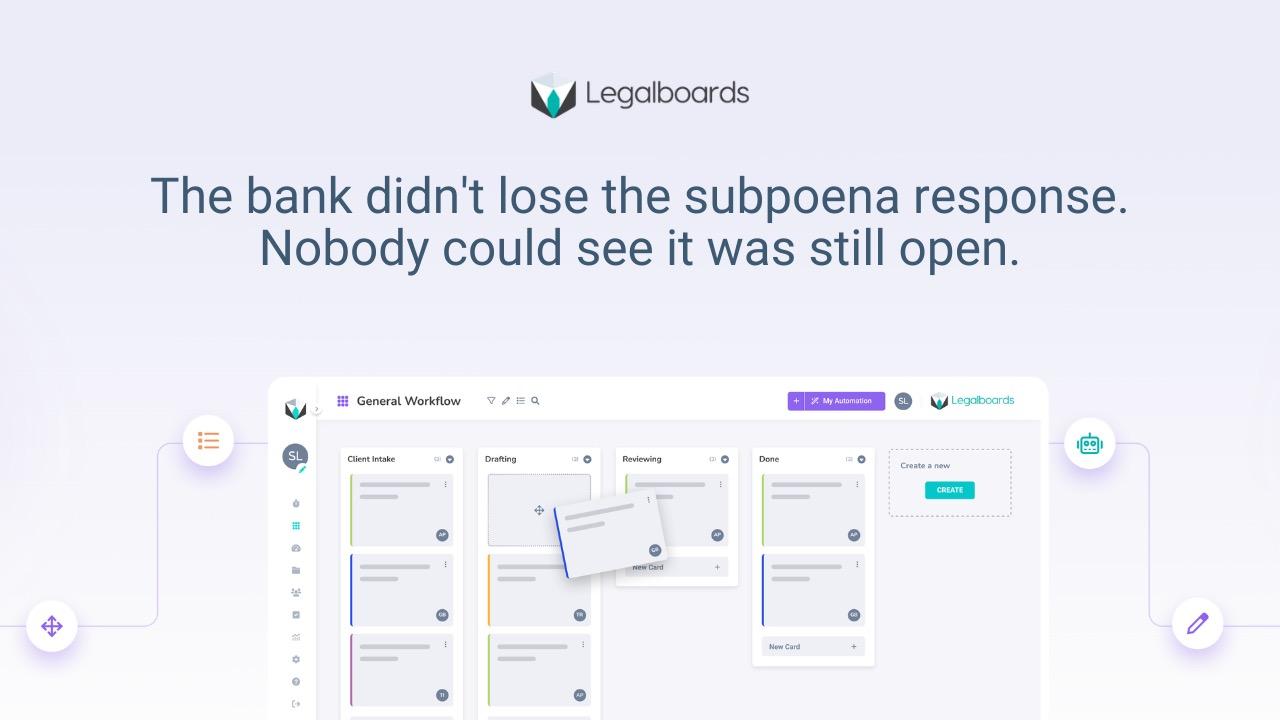
With Legalboards, a lead moving from "Contacted" to "Retainer Sent" automatically creates a task for whoever owns that stage, with a deadline attached. The paralegal does not have to remember to check; the task shows up the moment the prior stage closes. Clio stores the client and matter details. Legalboards shows where the lead actually stands and who is supposed to move it forward next. One office manager described the shift in this customer story, where intake stopped depending on any one person remembering to check.
Office managers who fix this usually start the same way: they map the current path a lead takes from first contact to retainer, write down every handoff, and assign one name to each step. That alone surfaces most of the law firm coordination problems hiding in the process. For more on the specific gap between an inquiry and signed client, this webinar on intake gaps walks through where firms typically lose leads.
Summary: The fix is not faster intake. It is assigned, visible intake, where every handoff has a name and a deadline attached to it.
How Slow Intake Costs More Than Lost Clients
Slow, invisible intake does not just cost the firm the lead that walked away. It costs paralegal and office manager time spent reconstructing what happened after the fact, and it adds to non-billable hours that never show up on an invoice.
When a partner asks "what happened with that lead from last week," someone has to stop active work to piece together an answer from email threads and memory. That is time the firm is paying for that produces nothing billable and nothing for the client. A firm that moved from an informal, memory-based intake process to a documented five-stage board with named owners cut the time from first contact to signed retainer by more than half, simply because no lead could sit unassigned.
Summary: Invisible intake has a cost beyond the lost client. It is the recurring, unbilled time spent reconstructing what already should have been visible.
Frequently asked questions
Why does client intake take so long at small law firms?
Intake usually takes long not because any single task is slow, but because handoffs between people are informal. A lead can sit for days simply because no one explicitly owns the next step, not because the work itself is difficult or time consuming.
How do I track law firm intake without buying new case management software?
Start with a single shared view, even a basic board, that lists every lead, its current stage, who owns it, and the date it last moved. The format matters less than having one place everyone checks instead of relying on email and memory.
Does Legalboards replace Clio for intake tracking?
No. Clio remains where matter and client records live once a case opens. Legalboards adds a visible workflow layer on top, showing where a lead or matter actually stands and who owns the next step, before and after the matter opens in Clio.
What is a reasonable response time for a new law firm lead?
Many firms aim for same-day or four-hour response windows, but the specific number matters less than consistency. A response time only helps if the firm can actually see whether it is being met, which requires visible status, not just a stated goal.
Who should own client intake at a small firm?
Ownership can sit with an office manager, a designated paralegal, or be split by stage, as long as each stage has exactly one named owner. Shared ownership without a specific name attached usually means no one is actually responsible.
What is the difference between workflow software and case management software?
Case management software, like Clio, stores matter details, documents, and billing. Workflow software shows how work moves between people and stages, including before a matter is even opened, which most case management systems are not built to track in detail.
How do I know if my firm has an intake visibility problem?
If someone has to ask "what happened to that lead from last week" and the answer requires checking multiple inboxes or asking around, that is a visibility problem. A documented workflow should make that question unnecessary.
If your firm is losing leads in the gap between first contact and signed retainer, see how intake moves through Legalboards → app.legalboards.io/register