A personal injury case isn't finished when the other side says yes. For the client, it's finished when the money arrives. The gap between those two moments is where a personal injury settlement workflow most often breaks, and it's the part of the case firms track least.
Everyone watches the demand and the negotiation. Almost nobody watches what happens after.
The case settled in March. The client is still waiting in July.
Here's a version most PI paralegals will recognize.
March. The adjuster accepts the demand. The attorney calls the client with good news. The client asks when they'll get paid. Someone says "a few weeks."
April. The release arrives from the insurer. It sits in the attorney's inbox for ten days because she's in depositions on another file. The client signs it two weeks after that.
May. The settlement check arrives and goes into trust. The paralegal starts the disbursement and finds a hospital lien nobody confirmed a final amount on, plus a health plan claiming reimbursement for treatment costs.
June. The hospital sends an amount that's higher than expected. The attorney wants to negotiate it down. The health plan hasn't answered the reduction request.
July. The client has called six times. Each time, whoever picks up has to go ask someone else what's happening.
Nobody dropped the ball in a dramatic way. Every step got done, eventually. What was missing was a visible list of what still stood between "settled" and "paid," and one person clearly owning each item.
Why the late stage of a PI case is so easy to lose
Earlier in the case, the work has natural pressure. Treatment is ongoing, records need collecting, and the demand has a clear goal. We covered the most common early stall, waiting on medical records, in a separate post.
After the offer is accepted, that pressure disappears. The case feels won. But the remaining work is a set of small, separate dependencies, and most of them rely on someone outside the firm:
- The insurer, for the release and the settlement funds
- Hospitals and providers, for final lien amounts
- Health plans or government payers, for reimbursement claims and reductions
- The client, for signatures on the release and the settlement statement
Each of those is waiting on a different party, on a different timeline. None of them shows up as a deadline on the calendar. So they stall quietly until the client calls.
The post-settlement stages worth tracking
A settlement workflow doesn't need to be complicated. It needs every stage visible and every open item owned. A structure that fits most small and mid-sized PI firms:
- Settlement agreed. Terms confirmed in writing, client informed, expected timeline shared honestly.
- Release out for signature. Reviewed by the attorney, sent to the client, returned to the insurer.
- Funds received. Check or wire received and cleared in trust before anything is paid out.
- Liens identified. Every provider, health plan and government payer with a potential claim, listed on the file.
- Lien amounts confirmed. Final numbers in writing, reductions requested where appropriate.
- Settlement statement signed. The client reviews and approves exactly how the funds will be split.
- Disbursement. Client, liens, fees and costs paid.
- Closed. File closed, client told it's done.
Liens are where most of the time goes. The mistake is treating "resolve the liens" as one task. It isn't. A file with a hospital lien, two provider balances and a health plan claim has four separate items, each with its own contact, its own follow-up date and its own status. Track them one by one, or the slowest one will hide behind the others.
What changes when the stages are visible
Three things happen when a firm tracks the settlement stage the same way it tracks the demand.
The client gets a real answer. Whoever picks up the phone can see the file is waiting on one health plan reduction and nothing else. No hallway search, no "let me check and call you back." That's the difference between real operational visibility and chasing case updates through the office.
Nothing waits on one person's inbox. The release that sat for ten days in April would have shown up as stuck in "Release out for signature" with a date on it. The problem isn't that the attorney was busy. It's that nobody could see the file was waiting on her.
Money moves faster. For a contingency firm, the fee arrives at disbursement, not at settlement. Every week a settled case sits unpaid is a week of cash the firm has earned and can't use.
This is also where handoffs between people tend to break. The attorney negotiates, the paralegal handles liens, someone else runs the trust account. Without a shared view, each of them assumes someone else is moving it forward.
How to start this week
- Pull every PI matter that has settled but not been fully disbursed.
- For each one, write down the single thing it's waiting on right now, and who's waiting.
- Break every "liens pending" note into individual liens, each with a contact and a follow-up date.
- Assign one owner to each open item.
- Share the list with the attorneys so they can see which files are stuck on them.
Most firms that do this find at least one file where a settled case has been sitting for weeks on something small, like a signature or a callback, that nobody was assigned to chase.
Where Legalboards fits
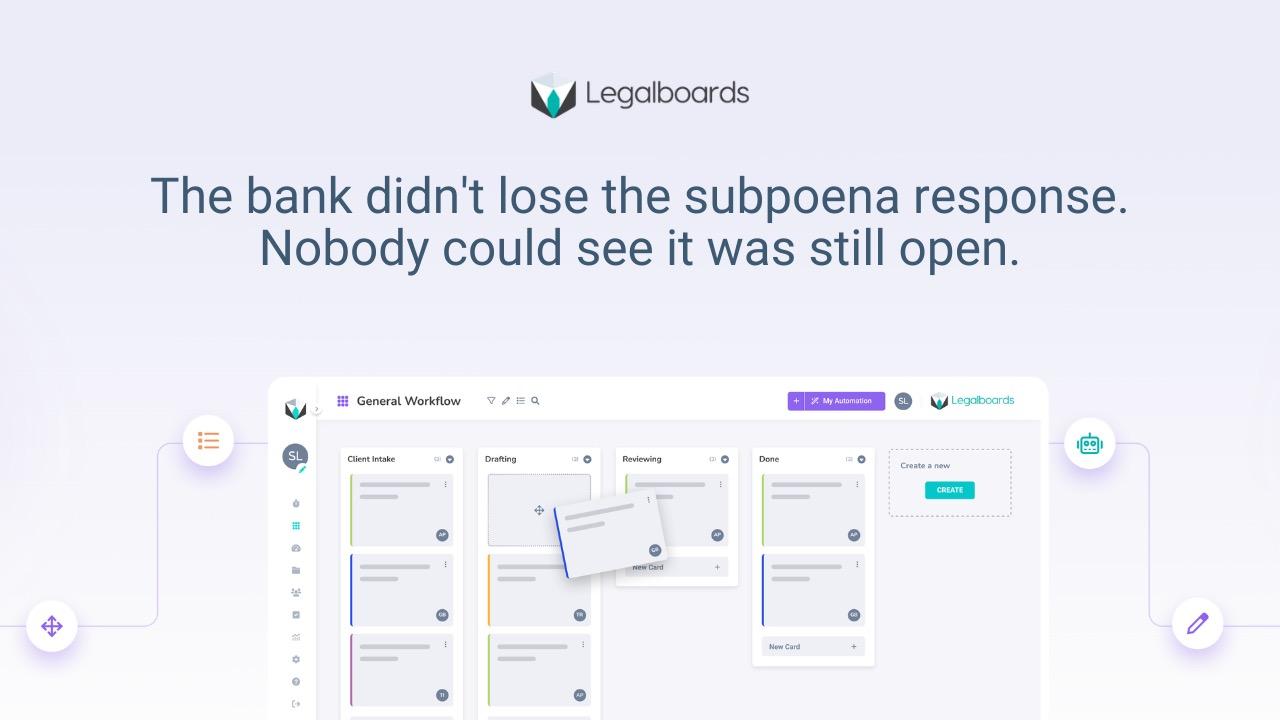
Legalboards sits on top of the case management system your firm already uses and gives each stage of a PI case, from intake to disbursement, its own visible place. Each open lien or signature can be its own card with an owner and a date, and automations can create the follow-up task when a card waits too long in one stage.
Partners see which settled cases are stuck and why, without calling a meeting. Paralegals stop answering "where's my money?" by asking around. For how PI compares to other practice areas, see law firm workflows by practice area.
Frequently asked questions
What is a personal injury settlement workflow?
It's the sequence of stages a PI case moves through after the offer is accepted: release, receipt of funds, lien resolution, settlement statement and disbursement. Tracking it as a workflow means every stage has an owner and every open item is visible to the whole team.
Why does it take so long to get paid after a personal injury settlement?
Usually because of dependencies outside the firm: the insurer's release and payment process, final lien amounts from providers, and reimbursement claims from health plans or government payers. Each has its own timeline. The delay gets worse when nobody at the firm is tracking those items one by one.
How should a firm track liens on a PI case?
List each lien as its own item, not as one "liens pending" note. Give each a contact, a requested final amount, a follow-up date and an owner. Mark reductions as a separate step so you can see which liens are confirmed and which are still being negotiated.
What should we tell clients while they wait for disbursement?
Tell them exactly what the file is waiting on and who is responsible for it. Clients handle a clear "we're waiting on the hospital's final lien amount, we follow up Tuesday" much better than "it's in process." You can only say that if the status is visible.
Does this replace our PI case management software?
No. Your case management system stays the record of the matter. A workflow layer shows how the work is moving across matters, what's waiting on whom, and which settled cases are stuck.
If your settled cases are waiting on steps nobody can see, try Legalboards free and map your post-settlement stages on one board.