
Most estate planning matters don't fail on the legal work. The will gets drafted, the trust gets reviewed, the documents get signed. What fails is the space between those steps, where a matter waits on a client, a review or a signature and nobody notices it's waiting. An estate planning checklist for law firms is only useful if it covers those gaps, not just the documents.
This page is the checklist we'd hand a new paralegal on day one. It walks through each stage of an estate planning matter, what "done" actually means at that stage, who should own it, and where it usually stalls. At the end, you'll find every estate planning resource we've published, in one place.
Why estate planning needs a checklist, not just a template
Estate planning looks simple from the outside. The documents are familiar and the steps rarely change. That's exactly why firms underestimate it.
The work is low-frequency, high-volume. A paralegal might carry 40 open matters, and most of them are quiet on any given day. Quiet looks like fine. But a matter that's been sitting in "waiting on client documents" for five weeks isn't fine. It's stalled, and the client is starting to wonder what they're paying for.
A document template tells you what to draft. A workflow checklist tells you what has to be true before the matter moves forward, and who makes sure it happens. If you want the deeper argument for why client-side follow-through is where most of these matters break, we wrote about it in estate planning workflow for law firms.
The estate planning checklist, stage by stage
The six stages below match the workflow most small and mid-sized estate planning practices already run, even if they've never written it down. Rename them to fit your firm. What matters is that every stage has a clear exit point and one owner.
Stage 1: Intake and conflict check
- Client contact and matter details entered in your case management system
- Conflict check run and cleared
- Engagement letter sent and signed
- Retainer received, if your firm requires one
- Initial consultation scheduled or completed
- Matter type confirmed: will only, will and trust, powers of attorney, health care directives, or a full package
Done when: the engagement letter is signed and the scope of the plan is confirmed in writing.
Owner: usually intake staff or the paralegal assigned to the matter.
Where it stalls: the engagement letter goes out and nobody tracks whether it came back. The matter looks "open" for weeks without the firm actually being engaged.
Stage 2: Document and information collection
- Client questionnaire sent
- Asset list received: real estate, accounts, retirement plans, life insurance, business interests
- Existing documents collected: prior wills, trusts, deeds, beneficiary designation forms
- Family information confirmed: spouse, children, guardians for minors, beneficiaries
- Fiduciary choices confirmed: executor, trustee, agents under powers of attorney
- Missing items listed and requested by name, not as "anything else you have"
Done when: every item the attorney needs to draft has been received and checked against the list.
Owner: the paralegal, with a follow-up date on every outstanding item.
Where it stalls: this is the longest stage in most firms, and the one with the least visibility. The client means to send the brokerage statements. They don't. Nobody follows up for three weeks because nobody set a date.
Stage 3: Draft preparation
- Planning decisions confirmed with the attorney
- Drafting assigned to a named person, with a target date
- Will, trust, powers of attorney and health care directives drafted
- Internal quality check: names, dates, asset references, fiduciary details
- Draft package assembled for attorney review
Done when: a complete draft package is ready and the attorney knows it's waiting for them.
Owner: the drafting paralegal or associate.
Where it stalls: drafting starts before collection is truly finished, then pauses halfway when someone realizes a deed or account statement is still missing.
Stage 4: Attorney review
- Review assigned to a specific attorney, not "the partners"
- Comments returned and changes made
- Revised draft approved
- Draft sent to the client for review, with a clear deadline for questions
- Client questions answered and final changes made
Done when: both the attorney and the client have approved the final documents.
Owner: the reviewing attorney for internal sign-off, the paralegal for the client loop.
Where it stalls: attorney review is the classic invisible queue. The draft sits in an inbox next to work that feels more urgent. Nobody asks because nobody can see how long it's been there. This is the same bottleneck we see in deadline tracking generally: the problem is rarely the deadline itself, it's the step before it.
Stage 5: Signing coordination
- Signing meeting scheduled with the client
- Witnesses and notary arranged, according to your jurisdiction's execution requirements
- Signing package prepared and checked
- Documents executed
- Signed originals scanned and stored
Done when: every document is properly executed and stored.
Owner: the paralegal coordinating the signing.
Where it stalls: scheduling. The client wants to bring their spouse, the spouse travels, and the meeting slides a month. Track the reschedule, not just the original date.
Stage 6: Funding, delivery and close
- Trust funding instructions sent: retitling deeds, accounts and other assets into the trust where the plan requires it
- Beneficiary designation updates confirmed where needed
- Deeds recorded, if applicable
- Final documents and summary letter delivered to the client
- Matter marked ready to invoice
- File closed, with a review reminder set for the future
Done when: the client has their documents, funding steps are confirmed or clearly handed to the client in writing, and the matter is billed.
Owner: the paralegal, with the attorney signing off on the closing letter.
Where it stalls: trust funding. A trust that was never funded may not do what the client thinks it does. Many firms hand the client a list and never confirm it was completed. Even if funding is the client's job, the firm should know whether it happened.
What makes this checklist actually work
A checklist on paper is a start. Three habits are what keep matters moving.
Every stage has a follow-up rhythm. If a matter sits in document collection for ten days without movement, someone should see it automatically. Not because they remembered, but because the system flagged it.
Every task has a name on it. "The team" doesn't follow up. A person does. If a task belongs to everyone, it effectively belongs to nobody.
The status is visible to the attorney without asking. If a partner has to walk down the hall to find out where a matter stands, the firm doesn't have visibility, it has interruptions. That's the core of operational visibility: status you can see, not status you have to chase.
Where Legalboards fits
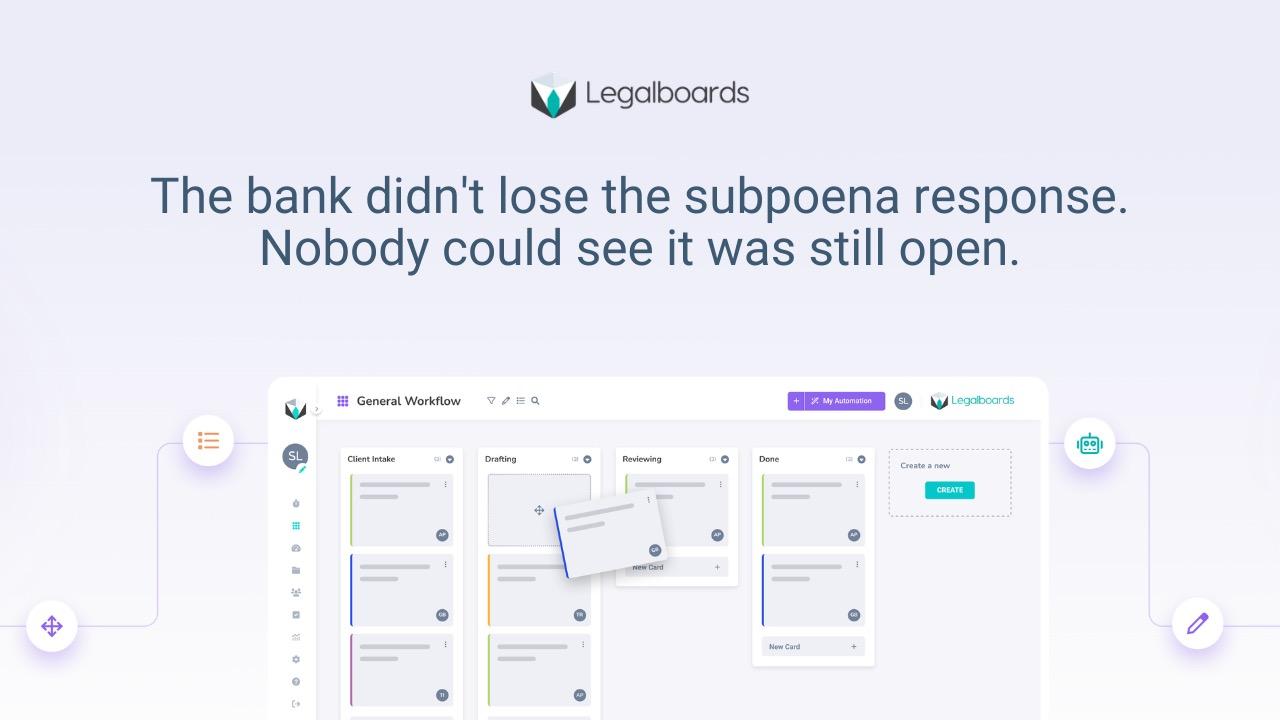
Legalboards gives each of these stages its own column, so every estate planning matter sits where it actually is. Automations can create the right tasks when a matter enters a stage, flag a matter that's been sitting too long, and move it forward when a key task is marked done. That's how a checklist stops depending on someone's memory.
It runs on top of the case management system you already use, so the matter record stays where it is. If you want to see what that looks like in practice, the resources below walk through it step by step. For how estate planning compares to other practice areas, see law firm workflows by practice area.
Go deeper: every estate planning resource in one place
- Estate planning workflow for law firms: why estate planning matters stall on the client side, with a matter that lost three months step by step.
- Estate planning board template: a ready-made board you can start from and customize to your firm's stages.
- Webinar: Estate Planning Automation, the Legalboards Way: Bruna Gonçalves builds a six-stage estate planning workflow live, using three trigger types: Move, Wait and Done. Prefer reading? Here's the written recap.
- Tutorial: How to automate your estate planning workflow: the step-by-step setup in Legalboards, stage by stage, including how to verify your automations before going live.
- Webinar: Tips & Tricks to Stay on Top of Your Estate Planning Cases: Audrey Ehrhardt of Practice42 on practical ways to keep estate planning cases moving and communication clear.
- Webinar: Growing and managing an elder law practice: for firms where estate planning sits alongside elder law work.
Frequently asked questions
What should an estate planning checklist for law firms include?
It should cover every stage of the matter, not just the documents: intake and conflict check, information collection, drafting, attorney review, signing, and funding and close. For each stage, define what "done" means, who owns it, and when someone follows up if it stalls.
Where do estate planning matters usually get stuck?
Most often in document collection, waiting on the client, and in attorney review, waiting on an internal queue. Both are quiet stalls. Nothing breaks loudly, the matter just stops moving until someone asks.
Who should own each stage of an estate planning matter?
One named person per stage. In most small firms, the paralegal owns intake, collection, signing coordination and close, the drafter owns drafting, and the reviewing attorney owns review. What matters is that ownership is explicit, not assumed.
Should the firm track trust funding after signing?
Yes, even when funding is the client's responsibility. At minimum, confirm in writing what the client needs to retitle or update, and record whether it was done. An unfunded trust is a common and avoidable gap.
Can we use this checklist with our existing case management software?
Yes. The checklist describes the workflow, not the software. Your case management system stays the record of the matter. A workflow layer like Legalboards sits on top of it and shows which stage every matter is in and what it's waiting on.
If your estate planning matters are moving on memory and sticky notes, try Legalboards free and set up these six stages on one board.