
It is 4 PM on a Thursday and the managing partner asks an office manager, "Did anyone follow up with that inquiry from Monday?" Nobody knows. The lead is gone, and the firm only learns it had a law firm intake visibility problem after the client already signed with someone else.
What Does Law Firm Intake Visibility Actually Mean?
Law firm intake visibility means anyone on staff can see, at a glance, every inquiry that has come in, what stage it is at, and who owns the next step. Without it, an inquiry can sit untouched for days and no one realizes it, because no one is actively watching for silence.
Most small firms think they have an intake problem with response speed. More often, they have a problem with not knowing an inquiry exists until someone happens to stumble across it.
Summary: Visibility, not speed, is the foundation of working intake. A fast firm with no visibility still loses leads it never noticed.
Where the Pipeline Actually Goes Dark
Inquiries arrive through a website form, a voicemail, a forwarded email, a referral text, sometimes a social media message. Each one lands somewhere different. A paralegal managing thirty active matters and an office manager handling billing, HR, and IT are both expected to "keep an eye on" intake on top of everything else they already do.
Here is what that looks like on an ordinary week. A referral comes in by text to a partner's cell phone. The partner means to forward it to the office manager and forgets for two days. By the time it gets forwarded, the prospective client has already called two other firms and signed a retainer with one of them. Nobody was negligent. The referral simply had no path into a shared system.
Intake stage tracking means logging every inquiry with a visible status as it moves: New, Contacted, Retainer Sent, Signed, Case Opened. Without it, the only record of where a lead stands is whatever the person handling it remembers, which disappears the moment that person is out sick or buried in a deadline.
Common signs a firm's intake pipeline has dark spots:
- Inquiries arrive through five or more channels with no single point where they all surface.
- No one is explicitly accountable for noticing when an inquiry has gone quiet for too long.
- The only way to check status is to ask the person handling it, who may not remember without checking multiple places themselves.
- A partner only learns about a lost lead after it is already gone, not while there was still time to follow up.
Summary: The pipeline goes dark at the points where inquiries enter without a defined next step or owner, not because anyone is ignoring their job.
What Visible Firms Do Differently
Firms with working intake do not necessarily respond faster. They simply make sure every inquiry, regardless of channel, lands in one place with a status anyone can check. A paralegal juggling active cases does not need to personally monitor five inboxes; she needs the inquiries to come to her in one view, already organized by stage.
With workflow automation, a new inquiry from any source can automatically create a task with a status and an owner, instead of relying on a person to notice it and manually log it somewhere. This is the same kind of operational visibility that closes other coordination gaps at small firms, applied specifically to the front end of the client relationship.
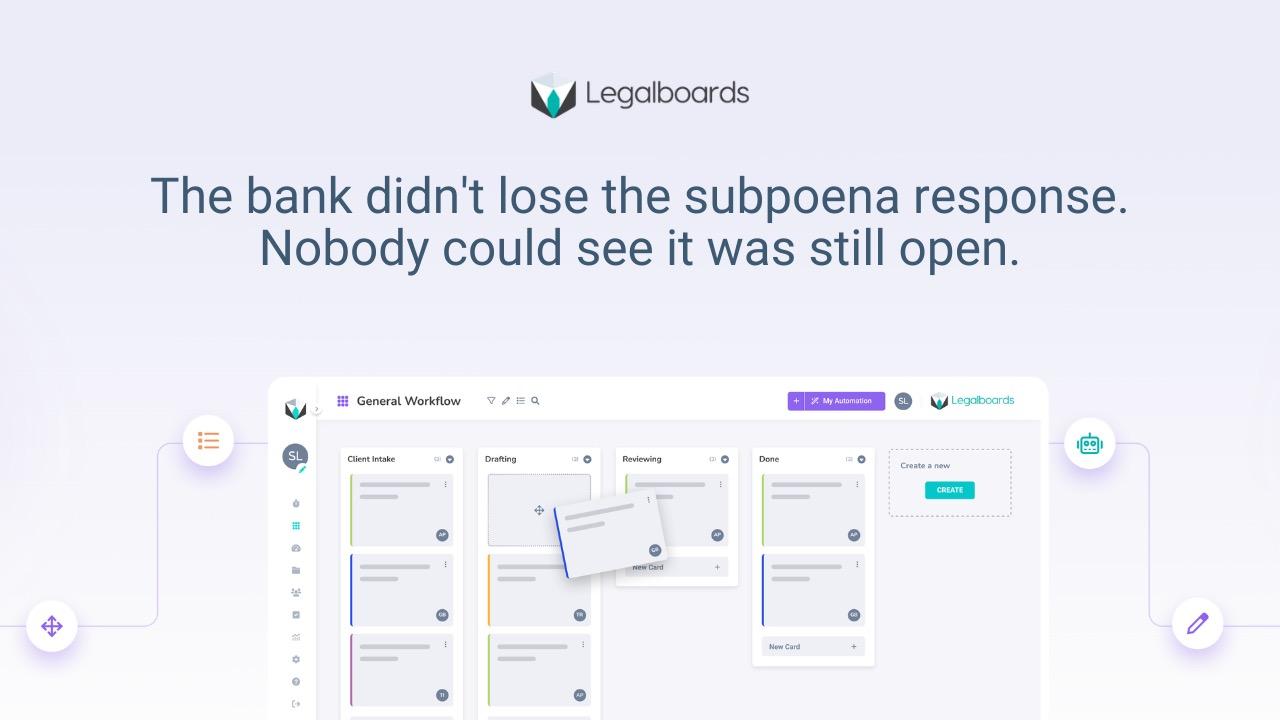
With Legalboards, a managing partner can check intake status without interrupting the office manager or the paralegal handling it, because the stage is visible to everyone, not locked in one person's head. Clio remains the system of record once a matter opens. Legalboards shows what is happening before that point, when most of the actual loss occurs. This is the same kind of shift described in this customer story, where an office manager stopped being the single point of failure for knowing what was happening with new leads.
Summary: Visible firms do not out-hustle the competition. They simply remove the blind spots where leads can disappear unnoticed.
How to Build Visibility Without New Software
Building this does not require enterprise tools or a long rollout.
- List every channel inquiries currently come through: website, phone, email, referral, social media.
- Create one simple status board, even a shared spreadsheet, with stages from New to Case Opened.
- Assign one person to own the process, not every channel personally, just the responsibility of making sure inquiries land on the board.
- Set a follow-up window, like four hours or same business day, and check weekly whether it is actually being met.
- Automate what is repetitive: acknowledgment emails, reminders when an inquiry sits too long without a status change.
A 2024 Clio Legal Trends Report noted that lead response and follow-up remain among the most common sources of lost revenue at small firms, often tied less to speed than to a lack of any tracked process at all.
Summary: A basic shared view and one accountable owner close most of the gap. Automation makes it sustainable once the process exists.
Frequently asked questions
Why does my law firm lose leads before a consultation ever happens?
Most pre-consultation losses come from an inquiry sitting unnoticed, not from a slow or bad response once someone sees it. If no one is watching for silence across every intake channel, a lead can go cold before anyone realizes it arrived.
How do office managers track intake on top of their other responsibilities?
The key is not personally monitoring every channel, but having every channel feed into one shared view with a visible status. That removes the need to check five separate places to answer "what's pending."
What is intake stage tracking?
It is logging each inquiry's progress through defined stages, like New, Contacted, Retainer Sent, and Signed, so anyone can check where a lead stands without asking the person handling it directly.
Can a small firm fix this without new case management software?
Yes. Most of the fix is process: one shared status view, one accountable owner, and a follow-up window the firm actually measures. Automation and dedicated tools help later, but they are not required to start.
Does Legalboards replace our existing intake forms or phone system?
No. Legalboards does not replace the channels themselves. It gives the firm one place where inquiries from any channel become visible tasks with owners and status, alongside Clio, which remains the system of record once a matter opens.
How fast should a law firm respond to a new inquiry?
There is no single right number, but firms that track response time consistently respond faster than firms that do not measure it at all. The tracking itself, not the specific target, is usually what changes outcomes.
What is the difference between an intake problem and a visibility problem?
An intake problem is a slow or bad response to a known inquiry. A visibility problem is not knowing an inquiry exists until it is too late to act. Most small firms that think they have the first actually have the second.
If inquiries are going dark before anyone notices, see how intake visibility works in Legalboards → app.legalboards.io/register