Law firm workflow structure is not a problem most partners think they have. Because from where a partner sits, the firm looks like it is running. Cases are open. The team is working. Nobody has flagged a crisis. So the assumption becomes: if something were wrong, someone would say so.
That assumption is the problem.
In a firm with no workflow structure, silence does not mean everything is fine. It means nobody has a reason to escalate yet. The task that stalled three days ago does not generate an alert. The document waiting on a client response does not turn red. The matter drifting toward a deadline has no signal attached to it until someone notices, and by then the margin is gone.
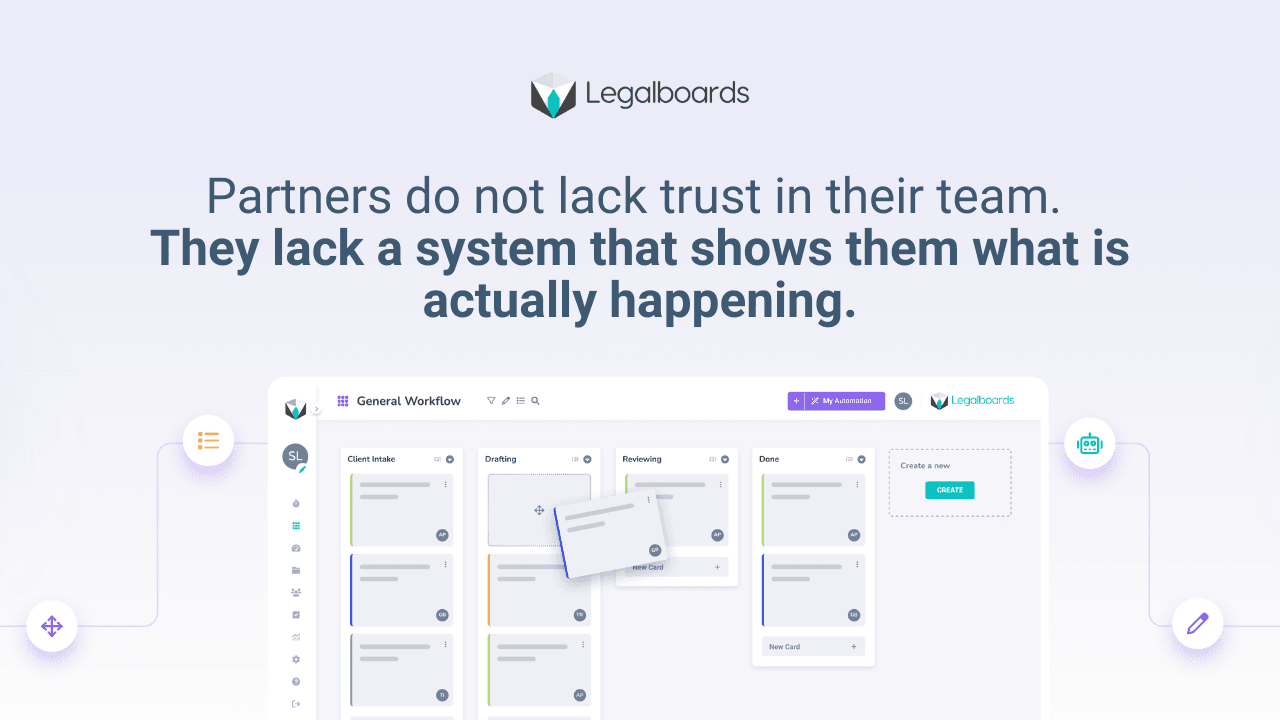
Partners do not lack trust in their team. Instead, they lack a system that shows them what is actually happening. That distinction matters, because the solution is not closer supervision. It is better structure.
The Visibility Partners Think They Have
Most partners believe they have a reasonable read on how their firm is operating. They review matters in client meetings. They hear about problems when someone brings them up. They track revenue and billing activity. For many, that feels like enough.
However, what partners see in those interactions is not a real-time view of operations. It is a filtered view, shaped by what the team chooses to surface and when. Good news travels easily. Problems travel slowly, and often only after someone has already tried to resolve them quietly.
This means partners regularly make decisions based on incomplete information. They approve capacity for new clients without knowing that three existing matters are behind. They enter client calls without knowing that a key document request has been waiting unanswered for ten days. They find out about deadline risk when the deadline is close, not when the risk first appeared.
Without law firm workflow structure, this filtered view becomes the default. Partners end up managing by exception, which means they only engage when something breaks visibly. Everything else runs on the assumption that no news is good news.
What “No News” Actually Means in an Unstructured Firm
Consider what no news actually means when a firm runs without defined stages, named ownership, or visible progress across matters.
First, it means that work sitting idle between steps looks exactly the same as work actively in progress. A matter waiting on a partner review and a matter moving through drafting both appear as open. Nothing distinguishes them. So when a partner scans the caseload, everything looks active even when significant portions are stalled.
Second, it means that the people doing the work compensate for missing structure by carrying that structure in their heads. Paralegals mentally track which matters need attention. Office managers remember which clients are waiting on responses. Associates know which drafts need review but have not been formally assigned. None of that knowledge lives in a shared system, which means it disappears the moment someone is out sick, takes leave, or leaves the firm.
Third, and most importantly, it means that risk accumulates quietly. Each small gap, such as a task without an owner, a step without a completion record, or a waiting status with no follow-up trigger, adds to an invisible backlog of exposure. Partners do not see it building. Instead, they see a sudden problem when the backlog finally surfaces.
This is precisely the pattern that law firm operational visibility is designed to prevent. Not by adding surveillance, but by making the actual state of work visible in real time.
The Three Things Partners Need to See That Most Firms Cannot Show Them
1. Where every active matter actually stands right now
Not where it stood in the last meeting. Not where the paralegal thinks it is. Partners need to open a view and see the current stage of every matter, what is in progress, and what is waiting, without asking anyone.
In most small and mid-sized firms, that view does not exist. The closest thing to it is a status meeting, which means the information is both delayed and filtered. By the time a matter's status reaches a meeting agenda, the situation has already changed or the team has already resolved it quietly.
For that reason, real-time matter visibility is not a reporting feature. It is an operational requirement. Partners who can see where work stands make faster, more accurate decisions, because they base those decisions on what is actually happening rather than on what someone remembers to mention.
2. What is stuck and why
Knowing that a matter is in the drafting stage is not enough. Partners need to know whether drafting is progressing or whether it has been sitting at the same point for four days waiting on a review that nobody has formally assigned.
This distinction, however, only exists when law firm workflow structure defines stages clearly enough to make waiting visible. Without structured stages, stalled work and active work look identical. Partners cannot identify bottlenecks they cannot see, which means those bottlenecks persist until they create enough pressure to escalate.
In contrast, a firm with structured workflows surfaces stuck work automatically. When a matter sits in one stage beyond a defined threshold, that signals a problem without anyone having to notice it first. Partners can then intervene early, before the stall becomes a deadline failure.
3. What is at risk before it becomes urgent
The most valuable thing law firm workflow structure gives a partner is early signal. Not confirmation that a problem exists, but indication that one is developing.
For example, when a deadline is ten days out and two prerequisite tasks remain incomplete with no confirmed owner, that is a risk signal. Without structure, nobody formally holds that information together. With structure, it surfaces automatically as a matter that needs attention.
As a result, partners move from reactive to proactive. Instead of finding out about deadline risk on day nine, they see the exposure on day three and redirect accordingly. That shift alone changes how a firm operates, because it removes the late-stage scramble that disrupts everything else on the team's plate.
Why This Is Not a Staffing Problem or a Trust Problem
When a firm operates without workflow structure and problems surface late, the instinct is to attribute the issue to individuals. Someone did not flag the problem early enough. Someone did not stay on top of their matter. Someone should have communicated more proactively.
That framing, however, misidentifies the cause. The people doing the work are often carrying enormous cognitive load precisely because the firm relies on them to compensate for missing structure. They track status in their heads because no system tracks it for them. They follow up manually because no trigger exists to do it automatically. They flag problems late because no process exists to surface risk early.
Building law firm workflow structure is therefore not about supervising the team more closely. It is about removing the reliance on individual memory and informal coordination that makes the firm fragile. As the workflow automation pillar explains, work does not fail inside tasks. It fails between steps, and between steps is exactly where structure either exists or does not.
What Workflow Structure Actually Looks Like for a Partner
A partner does not need to manage the workflow. They need to be able to see it.
In practice, that means opening a dashboard and seeing every active matter organized by stage. Matters in progress look different from matters waiting on external input. Matters with overdue tasks show that status clearly. Matters approaching a deadline with incomplete prerequisites surface as items that need attention.
None of this requires a partner to review individual tasks or manage daily work. Instead, it requires that the team works within a system where stages are defined, ownership is explicit, and progress is recorded rather than assumed. When those conditions exist, partners gain visibility without increasing their own workload or the team's overhead.
This is what operational visibility looks like at the partner level. Not a report generated weekly. A live view of how work moves, updated automatically as the team does its work.
How Legalboards Gives Partners the Visibility Their Firm Cannot Otherwise Provide
Legalboards builds law firm workflow structure on top of the case management system a firm already uses. Whether the firm runs on Clio, MyCase, or PracticePanther, Legalboards adds the workflow layer that makes matter progress visible to everyone, including the partner who needs to see across the whole firm.
Each matter moves through defined stages. Each stage has named owners and completion conditions. When something stalls, that stall shows up in the view rather than staying hidden in someone’s task list. When a deadline approaches with incomplete prerequisites, the system surfaces it before it becomes urgent.
Partners who use Legalboards do not need status meetings to know what is happening. They open the dashboard, see every matter’s current position, and identify anything that needs their attention. The firm visibility feature gives them the cross-matter view that most firms can only approximate through meetings and follow-up emails.
For firms concerned about implementation complexity, Legalboards does not require replacing existing tools. It connects to what the firm already uses and adds the structure layer that has been missing. Most teams notice the difference within the first week, because the time they previously spent chasing updates moves to doing actual work.
For a closer look at how deadline drift plays out when workflow structure is absent, the Deadline Drift webinar walks through a real scenario where one court date change creates cascading risk across the firm.
Frequently Asked Questions
What is law firm workflow structure and why do partners need it?
Law firm workflow structure is the system of defined stages, named ownership, and visible progress that governs how work moves across matters. Partners need it because, without it, they can only see what the team chooses to surface. Structure gives partners a direct, real-time view of where every matter stands, what is stuck, and what is at risk, without requiring meetings or manual updates.
How does poor workflow structure affect a partner’s decision-making?
Without law firm workflow structure, partners base decisions on filtered information. They approve new client capacity without knowing existing matters are behind. They enter client meetings without knowing a key document has been waiting for ten days. Because risk surfaces late in unstructured firms, partners consistently make decisions with less information than the situation actually requires.
Is workflow structure the same as micromanagement?
No. Workflow structure gives partners visibility, not control over every task. The goal is to surface risk early and show matter progress clearly, not to monitor individual activity. Partners who use structured workflows typically engage less in day-to-day work, not more, because they can see where attention is needed rather than having to check everything to find out.
What is the difference between case management and workflow structure?
Case management software stores information about matters, contacts, and billing. Workflow structure defines how work moves between stages, who owns each step, and what happens when something stalls. Most case management tools do the first thing well. However, they do not enforce movement, ownership, or visibility across stages, which is where law firm workflow structure fills the gap.
How quickly can a firm build workflow structure with Legalboards?
Most firms get their first workflow structured within a day. Legalboards connects to the case management system the firm already uses, so there is no data migration or parallel setup required. The Legalboards team helps firms define their first workflow stages, assign ownership, and start seeing matter progress in a single session.
See Every Matter Without Asking
Legalboards gives partners a live view of how work moves across the firm. Every matter. Every stage. Every risk visible before it becomes urgent.Start a free 7-day trial at app.legalboards.io/register — no credit card required.