
A paralegal checks voicemail Monday morning and finds a message from Thursday: "I need help with my case, please call me back." Nobody called. Nobody emailed. The law firm intake follow-up never happened, and that lead has already hired someone else.
Why Do Law Firms Lose Leads Before the First Call Back?
Law firms lose leads before the first call back because intake messages land in too many places at once: voicemail, a contact form, a forwarded email, a referral text. No single person can see all of it, so nobody notices a message sitting untouched for days.
This is not a speed problem. A firm can have a fast staff and still lose the lead, because speed only matters once someone knows there is something to respond to.
Summary: Leads go cold when intake messages are scattered across channels with no shared view. The fix starts with visibility, not faster typing.
Where the Follow-Up Actually Falls Apart
Here is a concrete version of the gap. A prospective client calls a 9-person estate planning firm on a Thursday afternoon and leaves a voicemail. The paralegal who normally checks voicemail is in a deposition all day Friday. By the time she listens to it Monday, the caller has already retained a competing firm. No one did anything wrong. There was no checkpoint that would have surfaced a four-day-old voicemail to anyone else on staff.
Intake channels are the separate paths a new lead can reach a firm through: phone, web form, email, referral, and walk-in. Each channel by itself is fine. The problem is that none of them report to a shared place anyone else can check.
A few signs this gap exists at a firm:
- One person is the only one who checks a given channel, so a single day of court or PTO creates a blind spot.
- No one can say how many leads came in last week without manually counting across inboxes and a voicemail box.
- Follow-up happens "when someone gets to it" instead of on a tracked timeline.
- A partner finds out about a lost lead after the fact, not while there was still time to act.
A Clio Legal Trends Report found that firms responding to a new inquiry within an hour convert meaningfully more leads than firms that take a day or more, but speed only helps once the message has actually surfaced. This connects directly to a broader law firm coordination problem: work depends on one person remembering to check several places at once.
Summary: The follow-up breaks down at the handoff between channel and person, not because anyone is slow once they actually see the message.
What Office Managers Can Put in Place
Closing this gap does not require new phone systems or new intake software. It requires one shared place where every new lead lands, regardless of which channel it came through, with a visible status and an owner attached.
With workflow automation, a voicemail transcript, a web form submission, and a forwarded referral email can all create the same kind of task in one place, so no channel is invisible just because one person happens to be unavailable. Office managers are usually the ones absorbing this gap today, which is exactly why operational visibility into intake matters more to them than to anyone else on staff.
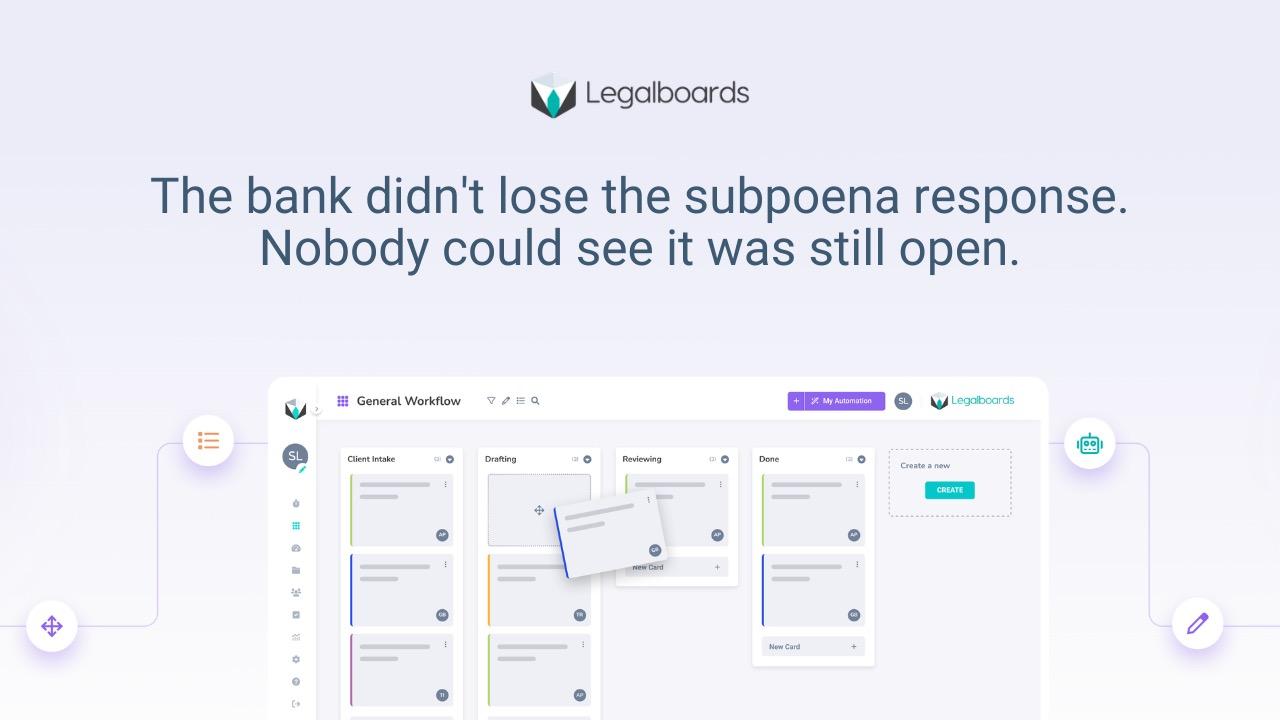
With Legalboards, a new lead from any channel creates a task with an owner and a due time the moment it comes in. Clio still stores the matter once it opens. Legalboards is what makes sure no lead sits unseen long enough to go cold. One office manager described a similar shift in this customer story, where intake stopped depending on whichever staff member happened to check the right inbox that day.
Summary: The fix is one shared intake view across every channel, not a faster version of the current scattered process.
What This Costs Beyond the Lost Lead
A lost lead is the visible cost. The hidden cost is the time spent afterward reconstructing what happened: checking voicemail logs, searching email, asking around to figure out whether anyone responded. That time adds directly to non-billable hours that never appear on an invoice.
A firm that consolidated its intake channels into one tracked view found it could finally answer "did we follow up" in seconds instead of reconstructing the timeline from memory every time a partner asked.
Summary: Invisible intake costs twice: once in the lead that walked away, and again in the time spent figuring out what happened after the fact.
Frequently asked questions
Why do potential clients stop responding after their first inquiry?
Often the inquiry was never actually missed by the client, it was missed internally. A voicemail or form submission sat unseen long enough that the prospective client assumed the firm was not interested or moved on to a faster-responding competitor.
How can a small firm track intake across phone, email, and web forms?
The format matters less than having one shared place every channel feeds into, with a visible status for each lead. Even a basic shared board beats five separate inboxes that no single person checks consistently.
What is a reasonable response window for a new legal inquiry?
Many firms aim for same-day or under-four-hour responses, but the number only helps if the firm can see whether it is actually meeting it. Visibility into response time matters more than picking an arbitrary target.
Does Legalboards replace our existing phone or intake form system?
No. Legalboards does not replace the phone system, the web form, or Clio. It adds a workflow layer that pulls new leads from each channel into one visible, owned task list so nothing sits unseen.
Who should be responsible for checking all the different intake channels?
One person can own the process without personally checking every channel, as long as each channel automatically surfaces into a shared view that person and others can see. Ownership of the process matters more than ownership of every channel.
How do I know if my firm has an intake visibility problem?
If a partner ever asks "did we follow up on that lead" and the answer requires checking multiple inboxes and a voicemail box, that is a visibility problem. A documented, visible intake workflow should make that question answerable in seconds.
Is losing leads during intake a staffing problem?
Rarely. Adding staff to check more inboxes more often treats the symptom. The underlying issue is usually that intake channels do not report to one shared, visible place, which more people checking more often does not fully solve.
If leads are going cold before anyone calls them back, see how intake follow-up moves through Legalboards → app.legalboards.io/register