Most law firms do not have a capacity problem. They have a coordination problem. Work piles up not because there is too much of it, but because it stalls between people. A draft sits finished for two days before the reviewer knows it is ready. A filing is held up by a document no one thought to request. The work is done — but nobody told the next person.
What coordination overhead actually means
Coordination overhead is all the time spent managing the movement of work rather than doing the work itself. Status emails. Follow-up calls. The "where are we on this?" message sent at 4pm on a Friday. The partner who checks in with three people before a client call just to confirm nothing is on fire.
In a typical small law firm, this adds up to 10 to 15 hours per person per week. Not because the team is disorganized — but because the firm has no structure for making work visible between steps. Every handoff requires a human to initiate it. Every status check requires a human to answer it. The work moves, but only when someone pushes it.
That is coordination overhead. And it compounds. The more matters in flight, the more pushing required.
The four places work stalls in a typical law firm
Law firm coordination problems are not evenly distributed. They cluster around four predictable points.
- After intake — nobody knows who picks it up next. A new matter opens. It is in the system. But unless there is a defined first step and a named owner, it sits in a kind of organizational limbo. Someone will eventually pick it up. The question is how many days pass before they do, and whether the client notices.
- After drafting — the reviewer does not know the draft is ready. The paralegal finishes a contract, a motion, a letter. They send an email. The email joins a queue of twelve other things in the attorney's inbox. Two days later, the attorney gets to it. The paralegal assumed it was being reviewed. Nothing was wrong. Nothing was urgent. But two days of buffer just disappeared.
- After review — the paralegal does not know to file. The attorney finishes revisions and saves the document. Now someone needs to prepare the final version, attach exhibits, and file. But there is no trigger. The attorney does not always think to notify. The paralegal does not always know to check. The matter stalls in the gap. This is where office managers tracking firm-wide workload lose visibility — the work is technically done, but it is not moving.
- After a client dependency — a document was requested but nobody is watching for the response. The firm sent a request. The client said they would get to it. A week passes. The matter cannot move without the document, but nobody is actively monitoring whether it has arrived. It sits open, quietly blocking progress, until someone remembers to follow up.
Each of these is a structural gap, not a performance failure. The people are capable. The system just does not connect them.
Why communication tools don't solve coordination problems
Email, Slack, and text are coordination tools. They are also why most firms believe they have solved their coordination problem when they have not.
These tools move information from one person to another. They do not make work visible to everyone who needs to see it. They do not surface stalls. They do not tell a partner which matters are at risk of a deadline tracking failure because a handoff was missed three days ago.
The problem is not communication speed. A Slack message arrives instantly. The problem is that work status lives in inboxes and memory — scattered across individual threads, invisible to anyone not copied, gone from view the moment the conversation moves on.
Faster communication does not fix a visibility problem. It just moves the invisible faster.
What a firm looks like when coordination actually works
The contrast is not dramatic. It does not require a new team or a different approach to law. It requires structure.
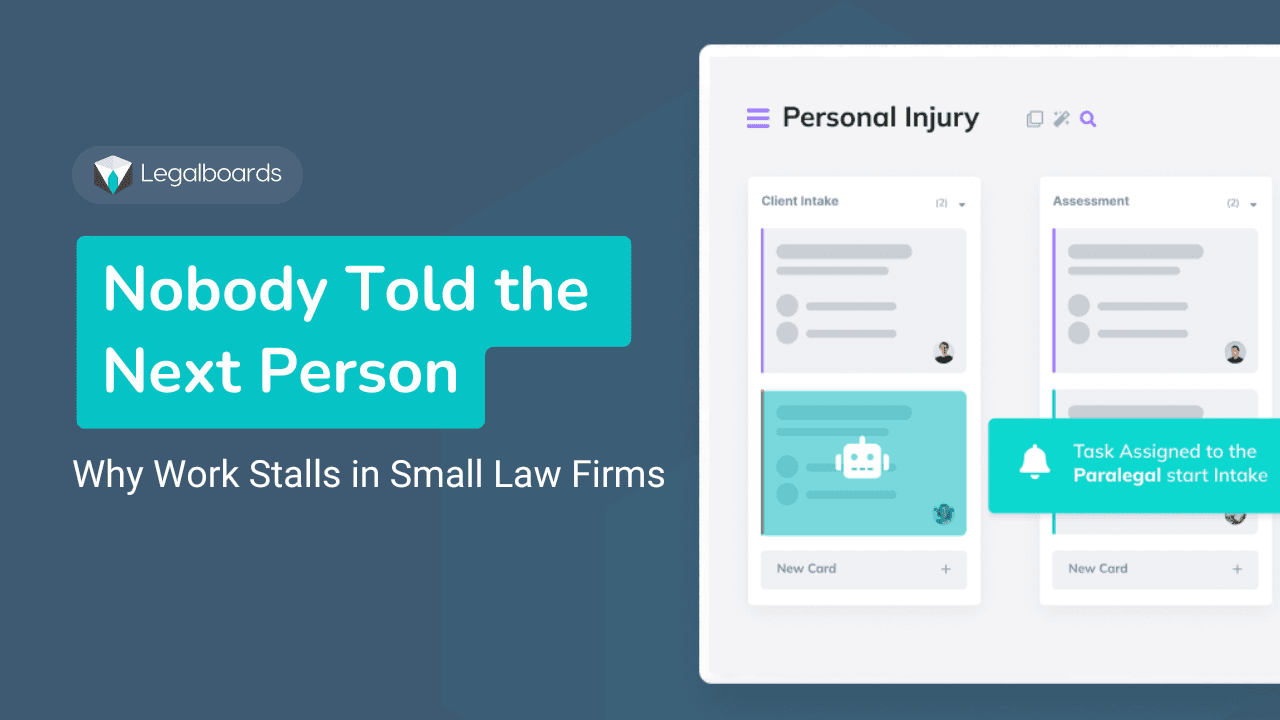
Every active matter has a current stage — specific enough that anyone in the firm can read it and know what needs to happen next without asking. Every stage has a named owner. When a stage completes, the next owner is notified automatically and the matter moves. Nobody has to push it. Nobody has to follow up. Workflow automation handles the transition.
Managing partners stop needing weekly status meetings to understand where the firm's workload stands — they can see it. Office managers stop being the human routing system for work that should route itself. Paralegals stop answering status questions and start doing the work they were hired for.
The firm does not get faster because people work harder. It gets faster because coordination overhead stops consuming the hours between steps.
How operational visibility removes coordination overhead
Operational visibility is not a dashboard you check. It is what happens when work is structured and owned at every step. When a matter is on a board with a stage and an owner, the board reflects reality because the work is in the board. The status is not reported — it is produced automatically by the structure.
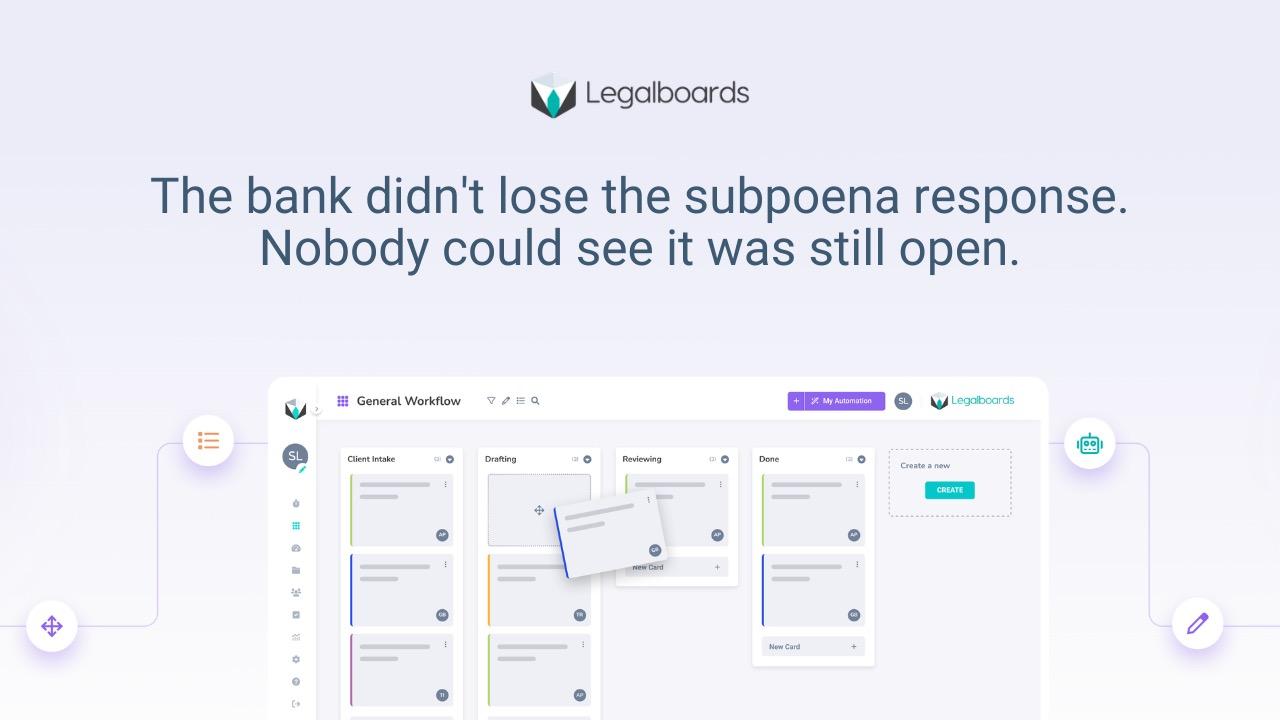
Legalboards is built on this principle. Matters move through defined stages. Each stage has an owner. Handoffs are automatic. Stalls surface without anyone asking. The result is not just visibility — it is the removal of all the coordination work that fills the gaps when visibility is absent. Partners see what is at risk. Office managers see what is blocked. Paralegals see what is next. Nobody has to ask.
Frequently asked questions
How do I know if my firm has a coordination problem versus a staffing problem?
A staffing problem means there is more work than the team can handle. A coordination problem means work is stalling between steps even when the team has capacity. If matters are sitting idle while people are available, if follow-up emails are a daily routine, or if status checks take more than a few minutes — that is coordination, not capacity.
Is coordination overhead different from a communication problem?
Yes. A communication problem is about information not reaching the right person. A coordination problem is about work not moving to the right person at the right time. You can have excellent communication and still have severe coordination overhead — every handoff in your firm might be confirmed by email, but if those emails are manual and delayed, the problem persists.
What is the fastest way to reduce coordination overhead in a small law firm?
Define your most common matter type as a structured workflow: name the stages, assign ownership to each one, and make handoffs automatic when a stage completes. Even one matter type running on structure will reduce the follow-up volume noticeably. Start with the matter type that generates the most internal status questions.
Does fixing coordination require changing how everyone works?
Not fundamentally. The work itself stays the same. What changes is how the transitions between steps happen — automatically instead of manually. Most people find it simpler, not harder, once the structure is in place.
How long before reduced coordination shows up in billable hours?
Most firms notice the change within the first few weeks of structured workflows running on active matters. The hours do not appear from nowhere — they were always there, just consumed by follow-up and status management. Once that overhead drops, the time is available for billable work.
If coordination overhead is a recognized problem in your firm, the operational visibility overview explains what structural visibility looks like and how firms typically start building it.