Back to Resources

When Your Law Firm's Case File Is Really an Email Thread

Tai Miranda Jul 2026 6 min read
When Your Law Firm's Case File Is Really an Email Thread

When Your Law Firm's Case File Is Really an Email Thread

A partner asks a paralegal what happened with a matter last touched three weeks ago. Law firm case status visibility usually breaks down exactly this way, one reply-all at a time. She scrolls back through a 40-message email thread, looking for the one reply that explains where things actually stand. That thread is not a communication record anymore. It has become the case file, and nobody meant for that to happen.

Why Does Case Status End Up Buried in Email?

Case status ends up buried in email because email is where decisions get made, not because anyone chose it as the system of record. A quick reply settles a question, an attachment goes out, a client confirms something in a one-line response, and none of it gets copied anywhere else because copying it felt like extra work in the moment.

A status of record is the single place a team agrees reflects the true, current state of a matter. When that place is an email thread, the record is only as good as everyone's inbox search skills, and it disappears the moment the person who received the key message is out sick or leaves the firm.

Email was never built to answer "where does this matter stand right now." It was built to hold a conversation. Firms that rely on it for status end up treating a conversation log as a status report, and the two are not the same thing.

What Gets Lost When Email Is the System of Record

Here is a concrete version of the problem. A client emails a question directly to the associate handling her case. The associate answers and resolves it in the same thread. The paralegal, who is supposed to track the matter's overall status, never sees either message, because she was not copied. Two weeks later, someone asks her for a status update, and she reports the case as further behind than it actually is, because her view of the matter is missing an entire exchange that happened outside her inbox.

This is not a communication failure between the associate and the client. It is a visibility failure: the resolution existed, but only in one person's inbox, invisible to everyone else responsible for the matter.

Law firm coordination problems like this compound as a firm grows. At five staff, everyone is roughly cc'd on everything. At twenty-five, email naturally fragments into overlapping, incomplete views of the same matters, and nobody has the full picture except by piecing threads together after the fact.

The paralegal searching for the right email is not being inefficient. She is doing the job the firm's systems should be doing for her: reconstructing status from scattered fragments because there is no single place that already shows it.

How Legalboards Gets Status Out of the Inbox

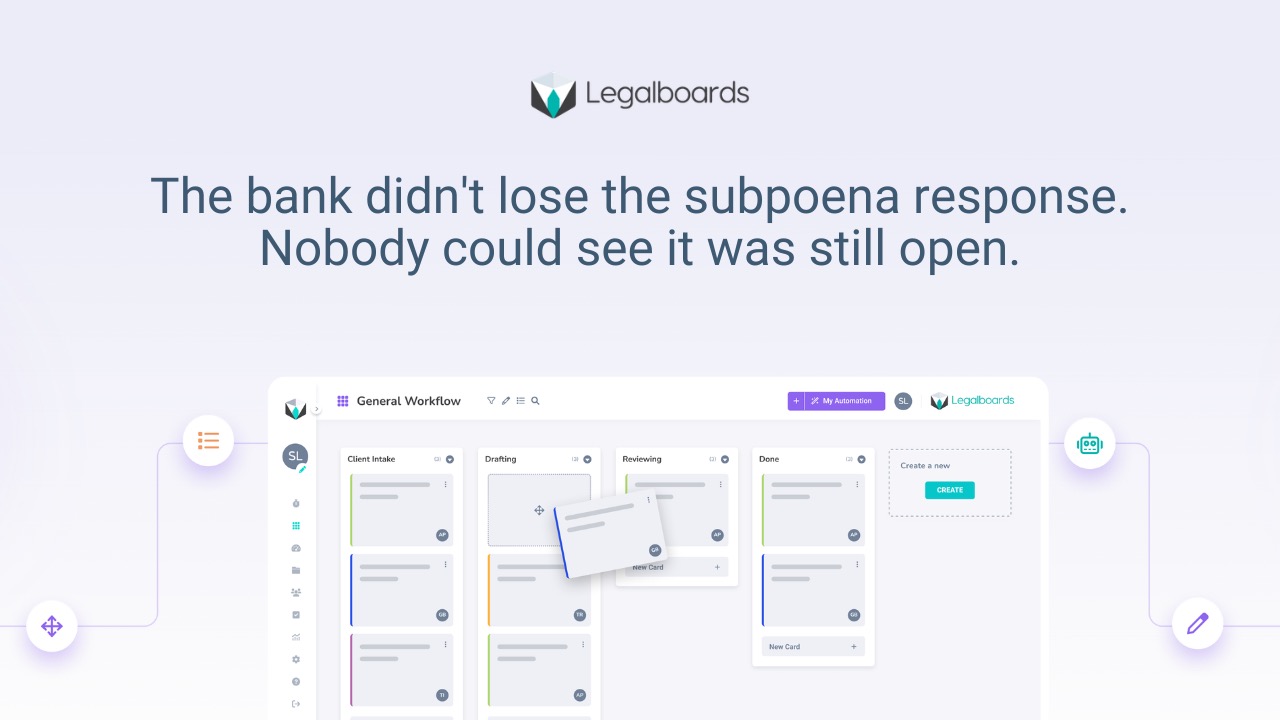
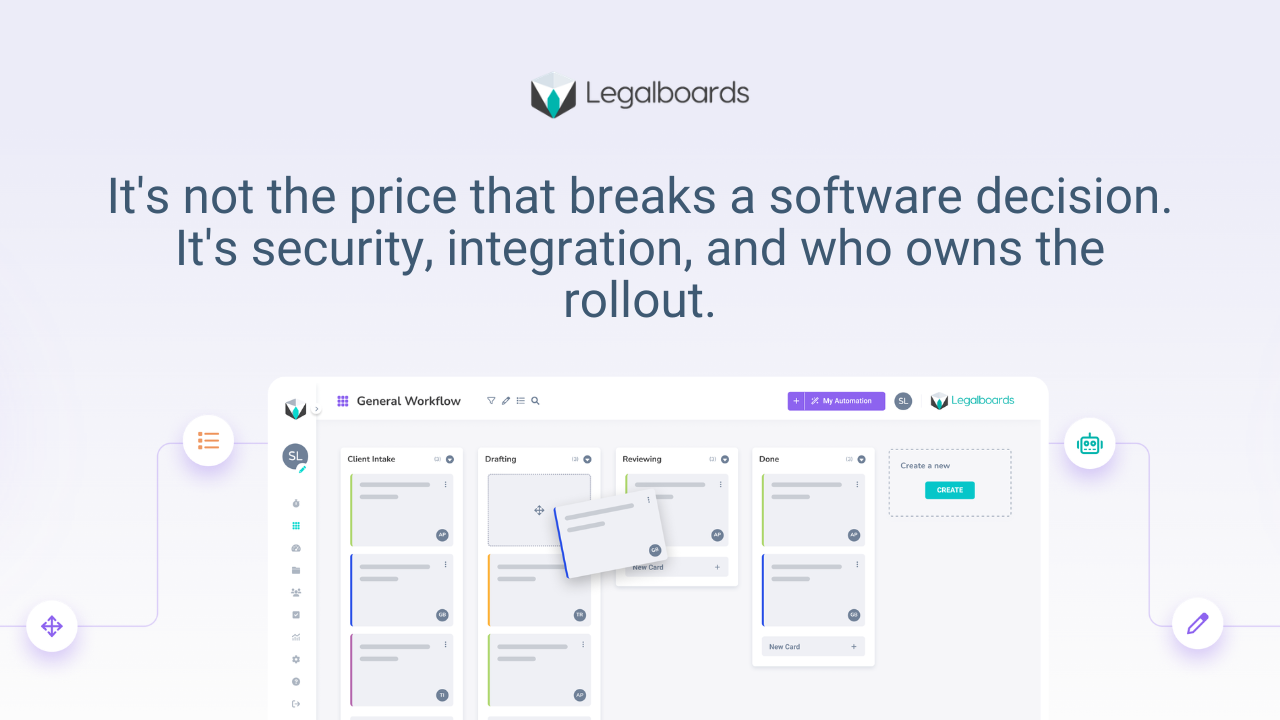
Legalboards does not try to replace email or stop people from communicating there. It gives every matter a status that lives outside any one person's inbox, visible to everyone who needs it without searching a thread.

With Legalboards, when a matter moves from one stage to the next, that update is visible on the board immediately, regardless of which inbox the triggering email landed in. A paralegal checking on a case does not need to guess who was cc'd on the relevant exchange. The current stage, the next action, and who owns it are already there. This is the kind of operational visibility one office manager described in the Simmons & Schiavo workflow automation story, where status stopped depending on being included on the right email chain.

Clio still stores the documents and the formal record. Legalboards makes sure the day-to-day status of where a matter stands does not quietly migrate into whoever's inbox happens to hold the most recent update.

What Searching Email for Status Actually Costs

The direct cost is time. Reconstructing status from a thread takes minutes that add up across dozens of matters a week. The biggest challenges in legal operations consistently include this kind of hidden coordination overhead, work that exists only because information is scattered rather than centralized. A 2024 Clio Legal Trends Report found that administrative and coordination work, much of it spent locating information that already exists somewhere in the firm, continues to eat into hours that could otherwise go toward billable client work.

Poor law firm case status visibility is rarely the result of one dramatic failure. It is the accumulation of small searches, each one a few minutes, repeated across every paralegal and every matter, every week.

The indirect cost is worse: decisions made on incomplete information. A partner who asks for a status update and gets an answer based on one person's inbox, missing the resolution that happened in someone else's, is making a call on a partial picture without knowing it. That is a bigger risk than the time spent searching.

Full law firm case status visibility does not require banning email. It requires a status that exists independent of any single inbox, so the answer to "where does this stand" does not change depending on who you ask.

Frequently asked questions

Why does my law firm keep losing track of case status?

If status only exists inside email threads, it is scattered across whoever was included on each exchange. Nobody has a complete view unless they were copied on every relevant message, which rarely happens as a firm grows past a handful of staff.

How can a small law firm track case status without new software?

Start with a single shared view, even a basic spreadsheet or board, that every matter's current stage gets logged to whenever it changes, regardless of which email triggered the update. The discipline matters more than the tool at first.

What is a status of record in a law firm workflow?

A status of record is the single place a team agrees reflects a matter's true current state. If that place is an email inbox, the record is incomplete by definition, since no one person is copied on everything.

Does Legalboards read or manage our email?

No. Legalboards does not access or manage email content. It gives each matter a visible status outside of email, so the team is not relying on inbox searches to answer where a case stands.

How do I know if my firm has a case status visibility problem?

If answering "where does this matter stand" requires searching an email thread or asking around, that is a visibility problem. A healthy system should make that answer available without digging through anyone's inbox.

Can email ever work as a case tracking system?

Email can work at very small scale, when one or two people handle everything and see every message. It breaks down as soon as more than a couple of people touch a matter, because no single inbox holds the complete picture anymore.

What is the difference between a communication record and a status record?

A communication record shows what was said and when. A status record shows where a matter currently stands. Email is a strong communication record and a weak status record, because status has to be pulled out of the conversation manually every time someone asks.

If your team is still reconstructing case status from email threads, see how Legalboards keeps it visible instead → app.legalboards.io/register

Ready to streamline your firm's workflow? Try Legalboards for free and keep every case moving forward.