
Why Change Is So Hard Inside Law Firms (and What Actually Works)
Most law firms know they need to change. New billing models, better workflows, smarter technology: the argument is rarely the problem. The decision stalls anyway, and the same conversation about change management in law firms comes up again six months later.
This isn't a logic problem. It's a change problem, and in law firms it runs deeper than most leaders realize.
The Lawyer Paradox
Lawyers are trained to be excellent at one thing: holding a position under pressure. That is the skill law school builds. It is what clients pay for.
Running a firm requires the opposite. It requires openness to new approaches, tolerance for uncertainty, and a willingness to shift course when something stops working. Those skills are not part of the same training.
Larry Bridgesmith has watched this tension play out for decades. He is a mediator with more than 30 years of practice and co-founder of the International Institute of Legal Project Management. He has sat at more negotiating tables than most attorneys ever will, and he has seen what actually moves people.
"Legal innovation is difficult because lawyers are very reluctant to take risks or change what they've done. The question is: how do you help people change their minds?" – Larry Bridgesmith, CEO of Legal Alignment
That question sits underneath almost every stalled initiative inside a law firm, whether it's a new case management process, a flat-fee pilot, or a tool the team was told to start using last quarter and quietly stopped.
Why the Standard Approach Fails
Most change initiatives in law firms follow the same script: present the data, explain the benefits, run the demo, wait for buy-in.
It rarely works. Not because the data is wrong, but because that approach treats resistance as an information problem. The assumption is that if people had enough facts, they would change. They don't.
Resistance to change in law firms is almost never about information. It is about identity, risk, and trust. A partner who has built a 20-year practice around billing by the hour is not failing to understand flat-fee pricing. They are protecting something the new model puts at risk.
Until identity, risk, and trust are addressed directly, no amount of additional data moves the conversation forward. This is the part most change management law firms attempt skips entirely, and it's why so many rollouts stall at the exact same point: agreement in the room, no movement after.
What Actually Works
Bridgesmith's approach draws from mediation, a field built entirely on moving people who are dug in. A few principles translate directly to firm leadership:
- Start with what's not working. Before proposing anything, name the friction people already feel. Change becomes easier to accept when it's framed as relief from an existing problem, not as disruption of something that works fine.
- Let people reach the conclusion themselves. A lawyer who argues their way into a position owns it. One who was talked into it by someone else will spend the next six months looking for reasons to reverse.
- Reduce the perceived risk. Pilots, limited rollouts, and opt-ins lower the stakes of saying yes. Lower stakes mean less resistance, and less resistance means faster decisions.
- Build trust before building the case. In mediation, relationship comes before resolution. The same order applies inside a firm. Skip it, and even a strong case lands flat.
None of these principles require new software or a bigger budget. They require sequencing the conversation differently than most firms do today.
This Applies Right Now
If your firm is navigating any of the following, the mechanics above are not theoretical:
- Introducing workflow management or task tracking software
- Moving from hourly billing to flat fees or a subscription model
- Getting partners aligned on a shared operational process
- Rolling out AI tools to a team that's openly skeptical
The challenge in each case is rarely the tool or the model itself. It's moving people, and that takes a different skill set than most firm leaders were ever trained for.
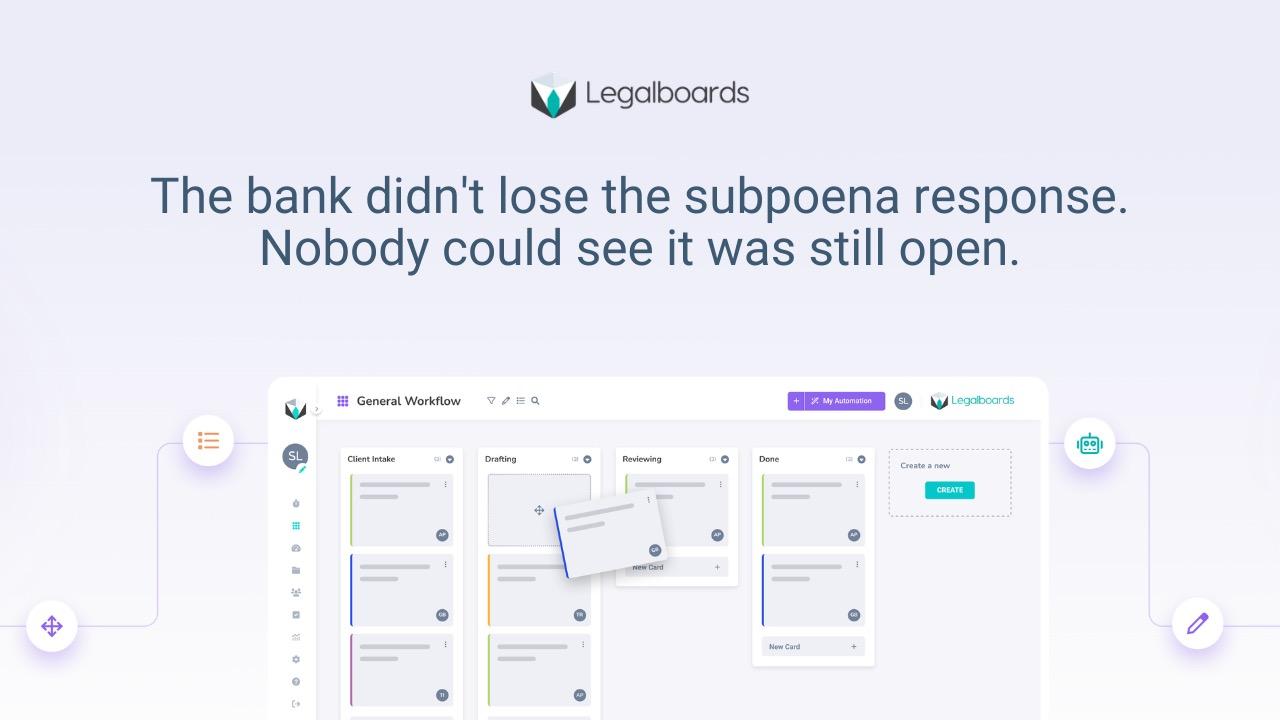
This is also where operational visibility matters more than people expect. With Legalboards, a paralegal or office manager can see exactly where a matter sits and who owns the next step, without a meeting and without chasing anyone down. That visibility removes one of the biggest sources of quiet resistance: the fear that a new system will create more work, not less. Clio still stores the matter. Legalboards just shows how the work is actually moving through it.
When change feels easier than the old way of doing things, adoption stops being a fight.
Watch the Full Session
Larry Bridgesmith covered all of this, and more, in a recent Legalboards Academy session.
If you're working through a change initiative at your firm right now and want a framework that actually fits how lawyers think, the session is worth 30 minutes of your time.
Frequently asked questions
Why do law firms resist change even when partners agree it's necessary?
Agreement on paper is not the same as agreement once the change touches someone's role, risk, or income. Lawyers are trained to hold positions and manage risk, which makes them naturally resistant to anything new until they have reached the conclusion themselves rather than been talked into it.
What is the biggest mistake firm leaders make when rolling out a new process or tool?
Leading with data and features instead of naming the existing friction first. Most resistance is about identity and risk, not information, so presenting more facts rarely moves a partner who is protecting something they have built over years.
How long does change management usually take inside a law firm?
It varies by firm size and what's changing, but pilots and limited rollouts move faster than firm-wide mandates. Lowering the stakes of saying yes, through an opt-in or a single practice group pilot, shortens the path to adoption significantly.
Can workflow software actually help with change management in a law firm?
It can, indirectly. Tools like Legalboards reduce the day-to-day friction that makes change feel like more work, which removes one of the biggest objections partners and staff raise before they have even tried something new.
Is this approach different for partners versus paralegals or office managers?
The core mechanics are the same, but the risk being protected differs. Partners often protect income models or client relationships. Paralegals and office managers more often protect their workload and routines. Naming the right friction for each group matters.
Who is Larry Bridgesmith?
Larry Bridgesmith, J.D., is the CEO of Legal Alignment, co-founder of the International Institute of Legal Project Management, a mediator with more than 30 years of practice, and faculty at Vanderbilt University School of Law and Arizona State University's Sandra Day O'Connor College of Law.
Where can I watch the full Legalboards Academy session with Larry Bridgesmith?
The full session, "How Lawyers Actually Change Their Minds," is embedded above and also available on YouTube. It covers the mechanics of change in more detail, including how to apply them to technology adoption, billing model shifts, and partner alignment.
If you're rethinking how work moves through your firm as part of a change initiative, you can see how matters move through Legalboards or explore the resources hub for more on workflow and operational visibility.
Ready to make change easier at your firm? Try Legalboards for free and give your team the visibility that removes resistance before it starts.