
Legal operations has its own vocabulary, and half of it gets used inconsistently even inside the same firm. "Matter management" means one thing to a software vendor and another to a managing partner. "Workflow" gets used interchangeably with "process," "task," and "system," often in the same sentence. This glossary defines 20 terms as they're actually used in day-to-day law firm operations, not as marketing copy, with a link to where you can go deeper on each one.
Legal operations
The function, formal or informal, of making legal work run efficiently: structuring how matters move, tracking deadlines, managing workload, and reducing coordination overhead. Most firms under 50 people don't have a dedicated legal ops role. They still do legal operations, it's just distributed across partners, office managers, and paralegals instead of centralized in one job title.
Legal project management
The discipline of running a matter with defined stages, clear ownership, and a visible path from intake to close. It doesn't require certification or a dedicated hire. See the full breakdown in the definitive guide to legal project management.
Case management software
A system of record for legal matters: client contacts, documents, court dates, billing, and communication history, all in one place. Tools like Clio, MyCase, and PracticePanther are case management software. It stores what happened. It generally doesn't show whether the work behind a matter is actually moving. See case management vs. workflow management.
Matter management
Often used interchangeably with case management, though some firms use it more narrowly to mean the administrative tracking of a matter's status, dates, and assignments. Whatever term your firm uses, the important distinction is the same one covered under case management: storing matter information is different from managing how the work inside it moves.
Workflow management
The operational layer that defines how work moves between stages, who owns each step, and what triggers the next action. Where case management answers "what is in this matter," workflow management answers "what needs to happen next, and is it moving." See law firm workflow automation.
Operational visibility
The ability to see where every active matter stands, who owns the next step, and what's stalled, without asking anyone. Most coordination problems inside a law firm are actually visibility problems wearing a workload costume. Full breakdown at operational visibility for law firms.
Docketing
The process of recording and tracking legally significant dates, court deadlines, filing dates, statute of limitations, on a matter. Docketing tells you when something is due. It doesn't, on its own, tell you whether the work required to meet that date has started. See law firm deadline tracking.
Deadline tracking
Monitoring not just the due date of a legal deadline but the status of the work required to meet it. Deadline tracking is broader than docketing: it covers whether drafting has started, whether review is complete, and where the work has stalled before the due date arrives. Full detail at law firm deadline tracking.
Statute of limitations (SOL) tracking
Monitoring the legal deadline by which a claim must be filed or it's permanently barred. SOL tracking is one of the highest-stakes forms of deadline tracking, since a missed statute of limitations date can end a case entirely, not just delay it. See law firm deadline tracking.
Stalled matter (stale matter)
A matter that hasn't moved forward in a defined window of time, work is waiting on a handoff, a review, a client response, or a signature, without anyone flagging it. Stalled matters are usually invisible until a deadline forces attention. Systems built for operational visibility flag them automatically. See operational visibility for law firms.
Handoff
The point where ownership of a task or matter transfers from one person to another, a paralegal finishing a draft and passing it to a reviewing attorney, for example. Most coordination failures in law firms happen at handoffs, not inside individual tasks. See law firm workflow automation.
Task chain automation
Linking a sequence of actions so that completing one step automatically triggers the next, instead of each step requiring a manual restart. A single automation saves one person one step; a task chain saves an entire handoff. See law firm workflow automation.
Stage-based workflow
Structuring a matter's progress as a defined sequence of stages, intake, drafting, review, filing, close, with a clear owner and outcome at each stage before it moves forward. Stage-based workflow is the structural foundation that makes automation and visibility possible. See law firm workflow automation.
Kanban board (for law firms)
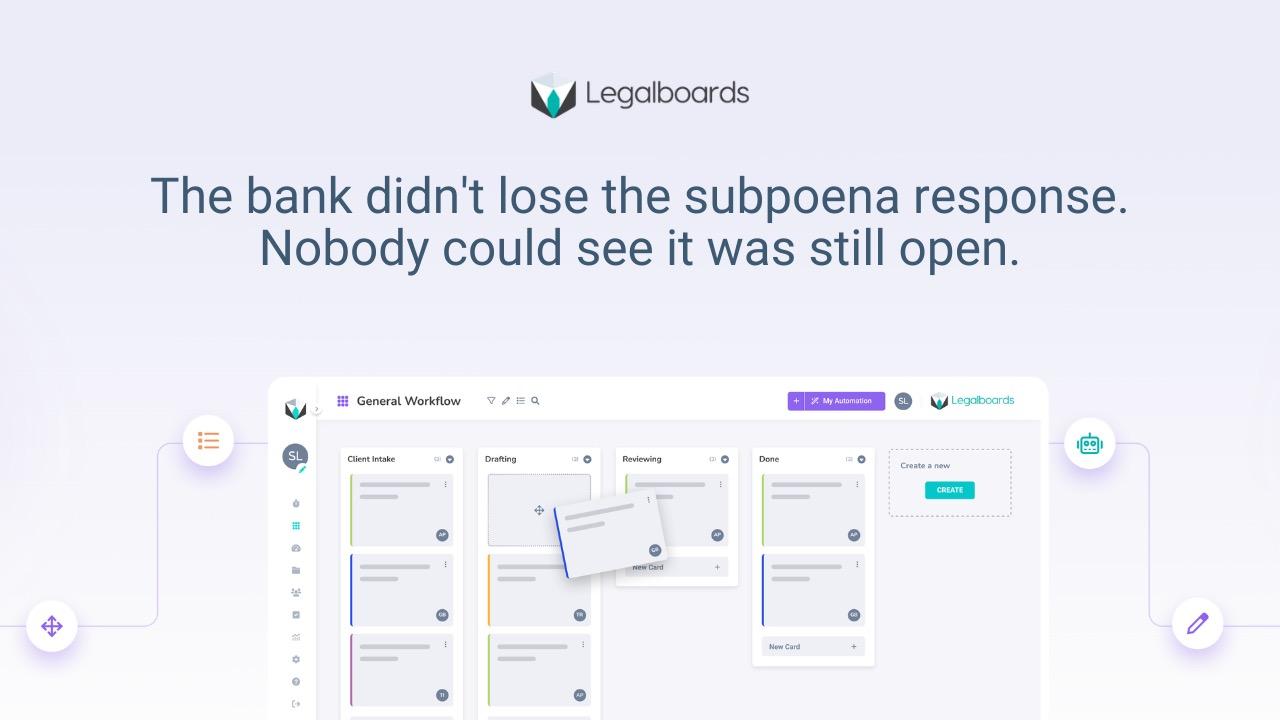
A visual board that represents matters or tasks as cards moving through columns representing stages. Originally a manufacturing concept, Kanban has become a common way for legal teams to visualize case status at a glance. See Kanban for lawyers.
Intake
The process of opening a new matter: capturing client information, conflict checks, engagement terms, and initial case details. Intake is often the first place workflow visibility breaks down, since it's where the most handoffs happen in the shortest window of time.
Non-billable hours
Time spent on work that can't be billed to a client, status meetings, follow-up emails, manual data entry across systems, chasing handoffs. Coordination overhead is one of the largest hidden sources of non-billable time in small and mid-sized firms. See law firm workflow automation.
Coordination overhead
The cumulative time and mental load spent keeping people, tasks, and information aligned: status updates, check-in meetings, manual follow-ups. Coordination overhead grows faster than headcount, which is why it hits small firms harder per person than large ones with dedicated ops staff. See operational visibility for law firms.
Legal tech stack
The full set of software tools a firm uses to run its operations: case management, billing, document management, e-signature, communication, and any workflow layer added on top. A fragmented tech stack, tools that don't talk to each other, is a common root cause of duplicate data entry and lost handoffs.
Workflow automation
Defining how work moves between stages and triggering the next action automatically when a stage is complete, replacing manual handoffs, follow-up emails, and status meetings with structured triggers. See law firm workflow automation.
Matter lifecycle
The full path a matter travels from intake to close, including every stage, handoff, and deadline along the way. Mapping the matter lifecycle for your firm's most common case type is usually the first concrete step toward legal project management. See operational visibility for law firms.
Frequently asked questions
What's the difference between legal operations and legal project management?
Legal operations is the broader function of making legal work run efficiently, covering everything from vendor management to budgeting to workflow. Legal project management is a specific discipline within that: how individual matters move through defined stages with clear ownership.
Is "matter management" the same as "case management"?
In most contexts, yes, they're used interchangeably to describe the software or process of storing and tracking matter information. Some firms use "matter management" more narrowly to describe administrative tracking specifically. The underlying distinction that matters more: neither one, by itself, shows whether the work inside a matter is actually moving.
Do small firms need to know all of these terms?
Not all at once. The terms that matter most day to day are the ones tied to where your firm actually feels friction, deadline tracking if dates are getting missed, workflow automation if handoffs are dropping, operational visibility if nobody can answer "where are we on this" without a meeting.
For a full walkthrough of how these pieces fit together, start with the definitive guide to legal project management.