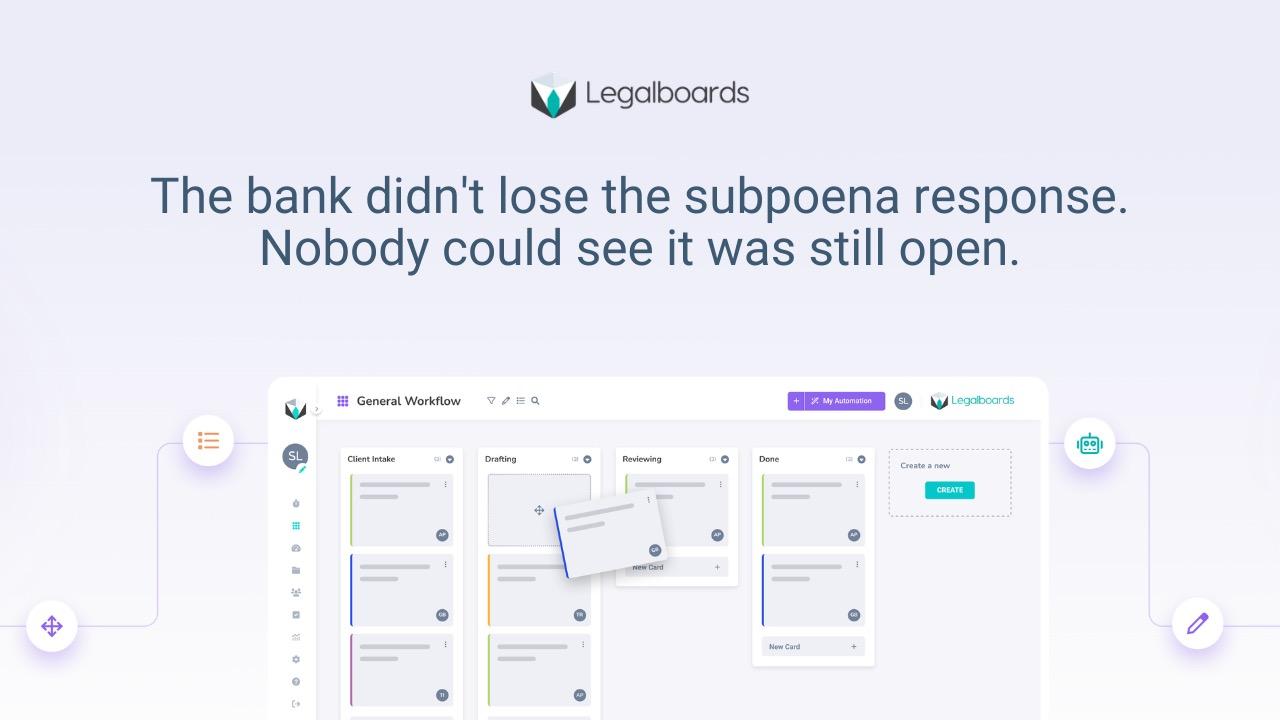

Most firms don't have a workload problem. They have a workflow problem: work moves from person to person with no defined stages, no visible ownership, and no way to see where a matter actually stands until someone asks. That's the gap legal project management is meant to close — running a matter the way you'd run any project, with defined stages, clear ownership, and a visible path from intake to close.
It's not a certification, a job title, or something only BigLaw needs. It's the difference between a firm where everyone can see what's happening and a firm where status only exists when someone asks for it.
Most firms already do pieces of this without naming it. Someone sets deadlines. Someone assigns tasks. Someone checks in when things go quiet. What's missing isn't effort — it's structure. Legal project management is what happens when those pieces stop depending on one person's memory and start living in a system everyone can see.
Why this matters even without a legal ops department
Legal project management got popularized by large firms with dedicated legal ops teams, formal methodologies, and software budgets to match. That origin story is exactly why small and mid-sized firms tend to dismiss it. If the articles all assume a legal ops hire and a Six Sigma framework, it's easy to conclude none of it applies to a 12-person firm.
It applies more, not less. A large firm can absorb coordination overhead with dedicated staff whose whole job is tracking status and chasing handoffs. A 12-person firm can't. Every hour a partner or paralegal spends asking "where are we on this?" is an hour not spent on billable work, and there's no ops team quietly catching what falls through.
You don't need a legal ops hire to run legal project management. You need four things applied consistently: defined stages for how matters move, clear ownership at each stage, visibility into what's stalled, and a way for handoffs to happen without someone remembering to make them happen.
Legal project management vs. case management
These two get confused constantly, and the confusion costs firms real money in dropped handoffs. Case management software is a record. It stores your matters, contacts, documents, and billing history. Legal project management is a practice. It's how the work inside those matters actually moves.
Case management tells you what's in a matter. It doesn't tell you whether the matter is moving. It shows a deadline on the calendar, not whether the work behind that deadline has started. It records that a document was uploaded, not whether anyone reviewed it.
For a fuller breakdown of where each one starts and stops, see case management vs. workflow management. The short version: your case management system is not designed to manage movement. It was never built to. That's a different problem, and it's the one legal project management solves.
The core problem: work fails between steps, not inside them
Most firms that feel overwhelmed don't actually have a workload problem. They have a workflow problem that looks like one.
Here's the pattern. A paralegal finishes a draft. It sits in the reviewing attorney's queue for two days because nobody flagged that it was ready. A client sends a signed document. It gets filed but nobody triggers the next step. A deadline is calendared, correctly, and everyone feels safe, right up until someone realizes the drafting behind it never actually started.
None of these are failures of effort. They're failures of visibility. The work inside each step usually gets done. What falls apart is the handoff between one step and the next, the moment where ownership has to transfer from one person to another and nothing in the system forces that transfer to be visible.
This is the single idea underneath everything else in this guide: if you want to fix how work moves through your firm, stop looking at how hard people are working and start looking at what happens in the gaps between tasks.
The building blocks of legal project management at a small firm
Once you accept that the gaps are the problem, legal project management breaks down into a short list of concrete practices. Each one below is its own deep topic, linked out for firms who want to go further.
Operational visibility. The ability to see where every active matter stands, who owns the next step, and what's stalled, without asking anyone. This is the foundation everything else sits on. Read the full breakdown in operational visibility for law firms.
Deadline tracking that covers the work, not just the date. A calendar entry tells you when something is due. It doesn't tell you whether the work behind it is on track. Real deadline tracking follows the stages leading up to a deadline, not just the deadline itself. More on this in law firm deadline tracking.
Workflow automation for the handoffs, not just the reminders. Most legal software automates single actions: a reminder, a template. Legal project management automates the connections between actions, so finishing one step triggers the next one without anyone having to remember. See law firm workflow automation.
A clear-eyed view of where AI actually helps. AI is now part of how many firms draft, summarize, and research. It doesn't remove the need for ownership and review; it changes what needs ownership and review. This pillar is getting a full treatment soon, and this guide will link to it once it's live.
Security and vendor evaluation as part of the process, not an afterthought. Whatever system you adopt to manage workflow touches client data. Knowing what to check before adopting new legal software is part of running legal project management responsibly, not a separate compliance exercise.
What it looks like when it's actually working
You'll know legal project management is working at your firm when status stops requiring a question. Nobody needs a Monday meeting to find out where a case stands. A partner can look at a board and see, without interrupting anyone, which matters are moving and which have gone quiet. A new paralegal can see how work is supposed to flow without shadowing someone for three weeks to learn the unwritten process.
None of that requires more staff. It requires the structure that was previously living in one or two people's heads to live somewhere everyone can see it.
Getting started without hiring a legal ops team
Start smaller than you think. Pick one matter type, the one causing the most friction right now, and map its actual stages: intake, drafting, review, filing, close, whatever it looks like for that practice area. Assign a clear owner to each stage. Write down what triggers the move from one stage to the next.
That mapping exercise alone surfaces most of the invisible gaps. You'll find the stage nobody actually owns, or the handoff that's always relying on someone remembering to send a message. Fix those first. Then decide whether you want a system to enforce that structure automatically, or whether a well-documented manual process is enough for your firm's size.
Most firms that make it past this first pass find that manual enforcement works for a while and breaks down as caseload grows. That's usually the point where a workflow layer, something built to make ownership and stage movement visible without relying on memory, starts paying for itself.
Frequently asked questions
Do I need a dedicated legal ops person to do legal project management?
No. Legal project management is a set of practices, not a job title. A firm of 5 to 50 people can run it by defining stages, assigning ownership, and making handoffs visible, without hiring anyone new. Dedicated legal ops roles become more common as firms scale past what a handful of people can track manually.
What's the difference between legal project management and workflow management?
They overlap heavily. Legal project management usually refers to the discipline: planning, scoping, and moving a matter through its stages. Workflow management is the operational infrastructure that makes that discipline repeatable across every matter of a given type, not just one at a time.
Is legal project management only relevant for litigation?
No. The core problem, work stalling in the gaps between steps, shows up in every practice area: estate planning waiting on signatures, family law waiting on court dates, personal injury waiting on medical records. The specific stages differ by practice area; the underlying discipline doesn't.
How is this different from just using a project management tool like Asana or Trello?
General project management tools are built for broad business use, not legal-specific handoffs. They don't understand matter stages, deadline dependencies, or legal-specific ownership structures out of the box. Legal project management as a discipline can be run with generic tools, but it takes real manual setup to make them fit, versus something built around how legal work actually moves.
Where should a small firm start?
Map one matter type's stages first, the one causing the most visible pain right now. Define who owns each stage and what triggers the next one. That exercise alone usually surfaces the biggest gaps before you decide whether you need software to enforce the structure automatically.
If you want to see what this looks like in practice, operational visibility and workflow automation are the two pillars most firms start with.