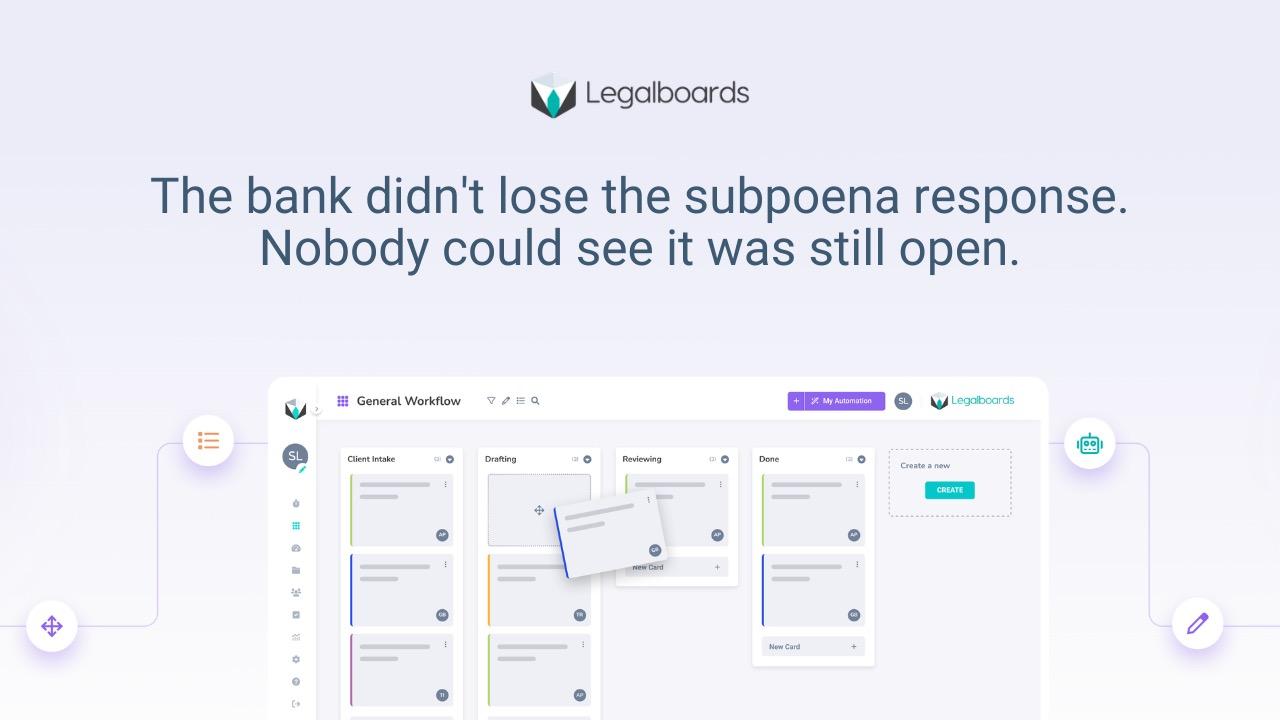

A partner insists the firm runs fine. Cases close, clients pay, nobody's quit this quarter. That's not proof the firm has law firm workflow management. It's proof the firm hasn't hit the size or complexity yet where the absence of it becomes impossible to ignore.
The five-question test
Ask five questions about any active matter at your firm. Can you name its current stage without opening the file? Can you name who owns the next step? Can you tell whether it's on schedule without asking the person handling it? Would a new person be able to pick it up today without a lengthy explanation? And if the person running it left tomorrow, could someone else instantly see where it stands?
If the honest answer to more than one of those is no, the firm doesn't have law firm workflow management, whatever software it's running. It has a set of tools that store data about matters, which is a different thing entirely.
Running the test on a real matter
Pick the busiest matter on the docket right now and actually answer the five questions about it, not hypothetically. Most partners get through the first two, stage and owner, without much trouble. It's the third question, whether it's on schedule without asking the person handling it, where most firms stall. The honest answer is usually "I'd have to check with them," which means the firm doesn't actually know, it's trusting that no news is good news.
The fourth and fifth questions are where the gap becomes obvious. A new associate picking up that matter cold would need a walkthrough, not because the matter is complicated, but because nothing about its current status lives anywhere a new person could find it on their own. And if the attorney running it left tomorrow, whoever inherited it would be starting from the file and a few old emails, not from a clear picture of where things actually stand.
What "running fine" actually hides
Firms that feel like they're running fine are usually running on a small number of people holding a large amount of context in their heads. That works, right up until it doesn't: someone gets overloaded, someone leaves, the firm adds a few more matters than usual and the informal system that's been quietly compensating finally shows a crack. This is exactly what partners tend to miss about their own firm's structure, or lack of it.
This is why "we're fine" and "we have workflow management" aren't the same claim. Law firm coordination problems rarely show up as a crisis. They show up as a slow accumulation of small delays and repeated interruptions that everyone's gotten used to treating as normal, right up until growth or turnover makes them impossible to absorb quietly anymore.
What workflow management changes
Workflow management is the practice of defining how work moves between people and stages, and making that movement visible instead of assumed. It's different from case management, which tracks what's true about a matter. Workflow management tracks whether the work behind that matter is actually progressing, and surfaces it the moment it stalls instead of after someone happens to notice.
Firms that build this don't necessarily do less work. They stop losing time to the coordination overhead sitting on top of the work: status checks, follow-up questions, reconstructing what happened while someone was out. That overhead is invisible in a headcount report and very visible in how much actually gets done in a week. A firm that closes the same number of matters with fewer status meetings and fewer "just checking in" messages didn't get lucky, it built structure that made those interruptions unnecessary.
The five-question test also tends to catch a problem before it becomes an expensive one. A firm that runs it honestly usually finds the gap on a handful of matters, not all of them, which is exactly where to focus first instead of trying to fix everything at once. The matters that fail the test are the ones most likely to surprise someone with a missed step or a stalled filing, precisely because nobody's watching them closely enough to catch it early.
How to start
Run the five-question test on your busiest practice area first. Wherever the answers break down is where to start building structure: defined stages, one owner per stage, and visibility that doesn't require asking anyone. That's a smaller project than it sounds, and it's the same starting point behind law firm workflow automation once a firm decides to build one deliberately instead of accumulating one by accident.
Frequently asked questions
How do I know if my firm actually has workflow management or just software?
Run the five-question test: can you name a matter's stage, its owner, whether it's on schedule, whether a new person could pick it up, and whether it would survive the current owner leaving, all without asking anyone. If more than one answer is no, the firm has tools, not workflow management.
Is a firm that "runs fine" proof it doesn't need workflow management?
No. Firms that feel fine are often running on a small number of people absorbing coordination work quietly. That holds until growth, turnover, or a busy season makes the gap impossible to ignore.
What's the difference between case management and workflow management?
Case management tracks what's true about a matter: documents, dates, billing. Workflow management tracks whether the work behind the matter is actually moving, and surfaces it automatically when it stalls.
Which of the five questions do most firms fail first?
Usually the third: whether a matter is on schedule without asking the person handling it. Most firms can name a stage and an owner, but "on schedule" almost always requires checking with someone, which means it isn't actually visible.
Where should a firm start building workflow management?
Run the five-question test on the busiest practice area first. Wherever it breaks down is where to define stages, assign one owner per stage, and build visibility that doesn't depend on asking someone directly.
If more than one answer in the five-question test gave you pause, see what law firm workflow management looks like built deliberately → app.legalboards.io/register