
Family law is not a practice area where disorganization shows up slowly.
A missed discovery deadline. A financial disclosure that was not followed up on. A client who called four times in a week because no one had updated them. These are not abstract risks. They are the predictable result of running a family law practice on informal systems.
The work itself is already difficult. Clients are going through some of the hardest periods of their lives. Matters involve multiple moving parts — filings, court dates, opposing counsel, financial disclosures, child custody evaluations — often running in parallel across dozens of active cases. The emotional temperature is high. The margin for error is low.
What makes the operational side of family law manageable is structure. Not more effort. Not more check-ins. A workflow system that makes every case's current status visible, every next step defined, and every deadline connected to the work that has to happen before it.
Why Family Law Workflows Break
Most small family law firms do not lack information. They lack a clear system for where that information lives and who is responsible for acting on it.
A paralegal is tracking 30 to 50 active matters across two or three attorneys. Each matter is at a different stage. Some are waiting for client documents. Some are waiting for opposing counsel responses. Some have hearings coming up in two weeks. Some have been sitting quietly for a month with no one checking in.
The paralegal knows all of this. It lives in their head, in their inbox, in their calendar, and in notes from the last meeting. When they are out sick or on leave, none of that is visible to anyone else. When a new matter comes in and the load shifts, something else loses attention.
This is not a failure of the paralegal. It is a failure of the system. And it is exactly the kind of failure that structured law firm workflows are designed to prevent.
The problem is not volume. It is that work moves informally — through memory and habit rather than through a defined structure. When a matter changes stages, the next step happens if someone remembers to make it happen. When a document request goes out, the follow-up happens if someone remembers to follow up. When a deadline approaches, the prerequisite work gets done if someone notices in time.
A structured family law workflow makes all of that explicit. Stages are defined. Ownership is assigned. The board shows you — without asking anyone — where every matter is right now.
What a Family Law Workflow Actually Needs
Before looking at specific workflow configurations, it helps to understand what makes any workflow functional in a legal setting.
A workflow is not a checklist. A checklist tracks tasks. A workflow tracks movement — what stage a matter is in, who owns it at that stage, and what has to be true before it can move to the next.
For family law specifically, a functional workflow needs:
Defined stages that reflect real phases. Not "active" and "closed." Stages that tell you something meaningful about where the matter actually is — Intake, Documents Pending, Discovery, Mediation Prep, Hearing Prep, Post-Hearing, and so on.
One owner per stage. Shared ownership is invisible ownership. Every matter in every stage should have one person responsible for the next movement.
Visibility into waiting. A significant portion of family law work involves waiting — for client documents, for opposing counsel responses, for court schedules. Waiting is not the same as progress. If a matter is stalled waiting for a financial disclosure from a client, that needs to be visible as a distinct state, not lumped in with active work.
Deadline connections. A filing deadline on the calendar has no context without the workflow behind it. Is the draft done? Has it gone to the partner for review? Is the client's signature secured? A workflow makes those dependencies visible. For more on this, see how law firm deadline tracking works through workflow rather than just calendars.
Three Ways to Structure a Family Law Workflow
The right approach depends on firm size, practice mix, and how cases differ from one another. Here are three configurations that work well for small family law firms.
Option 1: One Board Across All Family Law Matters
For firms where most matters follow a similar path regardless of case type, a single board covering all active family law cases works well.
Each column represents a stage. Each card is a matter. Color labels distinguish case types — divorce, custody, adoption, support modifications — without requiring separate boards for each.
A typical stage structure might look like:
Intake → Financial Disclosure Pending → Discovery → Negotiation / Mediation → Hearing Prep → Post-Hearing → Closed
The benefit of this approach is simplicity and visibility. One board gives a partner or office manager an immediate read on where every active case stands across the whole firm. When someone asks "where is the Henderson matter?", the answer is visible in three seconds without pulling anyone off their work.
The risk is that a single board can become too generic if case types diverge significantly. A contested divorce with three years of litigation looks very different from an uncontested adoption. When the stages do not apply cleanly to all case types, cards get stuck in stages that do not reflect reality.
Option 2: A Dedicated Intake Board
For firms managing high intake volume, separating intake from active case management is worth the additional structure.
The intake board handles everything from initial consultation through matter opening: inquiry received, conflict check, consultation scheduled, consultation completed, engagement decision, retainer signed, matter opened. Once a matter is opened and the engagement is confirmed, it moves to the main case board.
This separation matters for two reasons.
First, intake is where many small family law firms lose potential clients without realizing it. A prospect calls, someone takes a message, the callback happens two days later, the consultation gets scheduled but no one confirmed. The matter never opens because the intake process was informal.
Second, intake for family law specifically often involves sensitive screening — assessing conflict, understanding the client's situation, determining whether the matter is the right fit. Having a defined intake board makes that process consistent and visible rather than dependent on whoever picked up the call.
Option 3: Practice-Area-Specific Boards
For firms where different case types genuinely follow different processes, dedicated boards per matter type give teams the specificity to work clearly.
Divorce matters involve a distinct sequence: filing, service, financial disclosures, discovery, mediation (in most jurisdictions), settlement negotiation or trial preparation, and final order. Each of those phases has its own documents, deadlines, and ownership patterns. A divorce-specific board can map to that sequence directly.
A practical divorce workflow might run:
Filed → Service Confirmed → Financial Disclosures Out → Discovery → Mediation Scheduled → Settlement Negotiation → Final Order Prep → Closed
Adoption matters follow a fundamentally different process: home study coordination, background checks, agency or court filings, ICPC compliance if interstate, finalization hearing preparation. The steps are different enough that sharing a board with divorce matters creates confusion rather than clarity.
An adoption workflow might look like:
Intake / Eligibility → Home Study Initiated → Background Checks → Agency / Court Filing → Placement → Finalization Prep → Finalized
The trade-off with dedicated boards is overhead. More boards means more to maintain. For a small firm with two attorneys, running four separate boards can become its own management burden. The right number of boards is the minimum needed for the stages to be meaningful — not one per possible case variation.
Where Family Law Workflows Break in Practice
Understanding the failure points matters as much as understanding the structure. These are the stages where family law work most commonly stalls.
Document collection. Clients in family law matters are often slow to provide financial records, tax returns, and supporting documentation — sometimes because of the emotional difficulty of the process, sometimes because they do not understand what is needed. Without a defined stage for "documents pending" and a follow-up trigger when nothing has arrived in seven days, this waiting becomes invisible. The matter sits. The deadline gets closer. Nothing moves.
Partner review. Drafts move from the paralegal to the attorney for review. The attorney's calendar fills up. The draft sits for two weeks. No one follows up because the paralegal does not want to seem like they are nagging, and the attorney assumes it is not urgent. A workflow with defined ownership and an inactivity trigger removes the social awkwardness from that follow-up — it becomes the system's job, not the paralegal's.
Post-mediation / post-hearing. When a hearing or mediation concludes, what happens next? In many firms, the answer is: it depends. Someone takes notes. An email gets sent. If there are action items, they may or may not be formalized. Cases can sit in a kind of limbo — technically progressing but operationally unowned — because the workflow was not designed to handle what comes after a major milestone.
Defining a "Post-Hearing" or "Settlement Drafting" stage explicitly, with a clear owner and next action, closes that gap.
Client communication. Family law clients often feel anxious and underinformed. When there is no structured point in the workflow for client updates, clients fill the void by calling. Those calls consume paralegal time, create interruptions, and signal to the client that the firm is not on top of their matter. Automating a client status update when a matter moves to a new stage — without the paralegal having to remember to send it — reduces inbound call volume and improves the client experience simultaneously.
For more on how automation handles the repetitive coordination layer, see law firm workflow automation and where it reduces non-billable work.
What Operational Visibility Looks Like in Family Law
The practical test of a workflow system is whether it eliminates the question "where does this matter stand?"
For a partner with 40 active family law matters, that question should be answerable in under 30 seconds without interrupting anyone. For an office manager trying to understand team capacity, the board should show them which attorney has how many matters in which stages without requiring a weekly meeting to compile the information.
For paralegals — who carry the operational burden of most family law firms — the board should make the next action on every matter visible at the start of each day. Not a mental reconstruction from memory and email. A clear, current view.
This is what operational visibility means in practice. Not reporting for its own sake. Information that removes the coordination overhead from daily work and lets people focus on the work itself.
Building Your Family Law Workflow in Legalboards
Legalboards includes workflow board templates designed specifically for family law practice areas, including divorce and custody matters.
Each template gives you a starting point — a set of stages that reflect how family law work actually moves — that can be adjusted to match your firm's specific process. You can run one board across all family law matters or create separate boards for divorce, adoption, custody modifications, and support matters, depending on your volume and case mix.
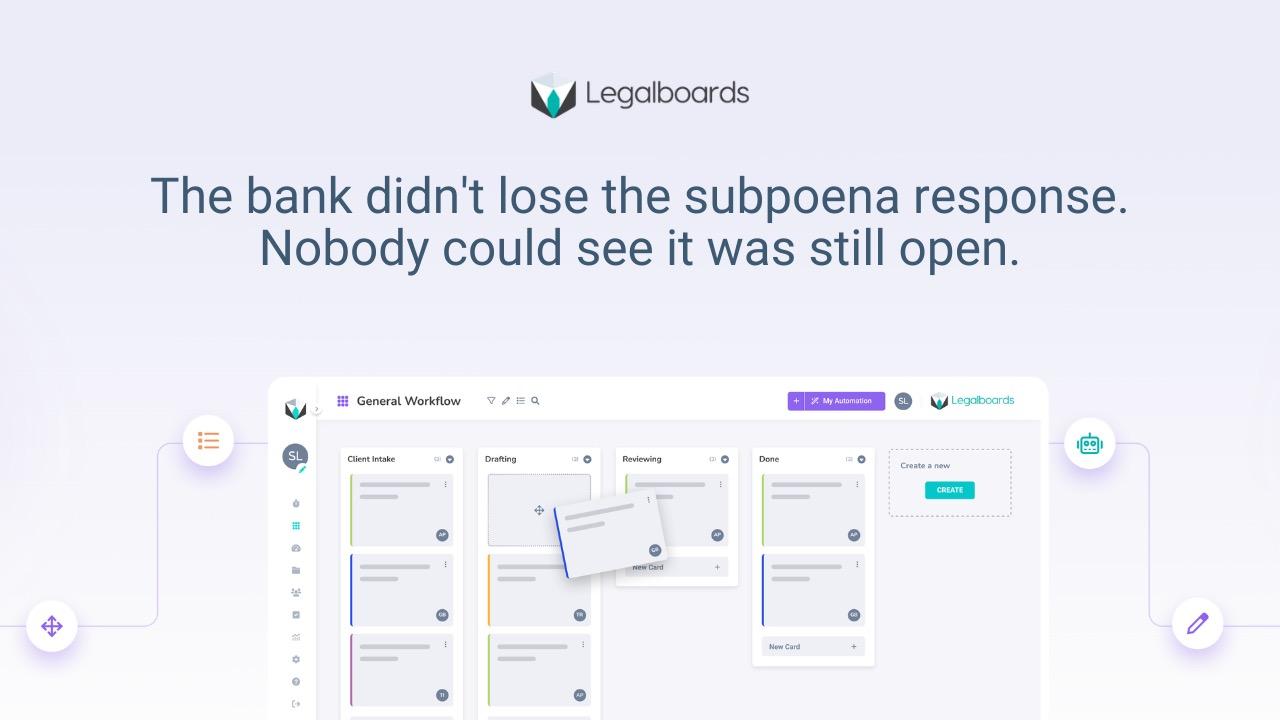
Every matter card includes stage assignment, ownership, key dates, and notes. When a matter moves to a new stage, task automations can trigger the next step, send a client update, or flag a follow-up for whoever owns the next action — without anyone having to remember to do it manually.
Legalboards integrates with Clio, PracticePanther, and MyCase, so matter information does not live in a separate system. The workflow board sits on top of the case data already in your practice management tool.
If you want to see how a family law workflow board looks in practice, book a free demo and we will walk through the setup for your specific practice area.
---
Frequently Asked Questions
What is a family law workflow?
A family law workflow is the structured sequence of stages that moves a matter from intake to resolution — filing, discovery, mediation, hearing preparation, and final order — with clear ownership at each step. Unlike a checklist, a workflow tracks the movement of the matter through defined phases so everyone on the team knows where every case stands without asking.
How many stages should a family law workflow have?
Between five and eight stages covers most family law matter types without creating too much overhead to maintain. Too few stages and the board does not tell you enough. Too many and cards pile up in stages that do not mean anything. The right stages are the ones that represent genuinely distinct phases of your work — where ownership changes, where waiting is distinct from progress, and where a new stage means new action.
Should a family law firm use one board or multiple boards?
It depends on how different your matter types are from each other. If divorce, custody, and support matters follow roughly the same process, one board with color labels works well. If adoption or guardianship matters involve a genuinely different sequence of steps, a dedicated board for those matter types is worth the additional structure. Start with one board and split only when the stages stop being meaningful across case types.
How does a workflow board help paralegals in family law firms?
A workflow board gives paralegals a current view of every active matter without having to reconstruct status from memory and email. At the start of each day, the board shows what stage every matter is in, what is waiting for client documents, what is approaching a deadline, and what needs to move. That clarity reduces reactive scrambling and makes it possible to prioritize work proactively rather than responding to whoever is most recently asking.
What is the difference between a workflow board and a case management system?
Case management software — Clio, PracticePanther, MyCase — organizes client records, documents, billing, and deadlines. A workflow board tracks how work moves between people: what stage each matter is in, who owns the next step, and where work is stalled. They answer different questions. Case management answers "what is in the file?" A workflow board answers "is the work actually moving?"
How does workflow structure help with family law client communication?
When a workflow board includes a defined stage for client updates, or when automation sends a client notification when a matter moves to a new phase, clients receive timely information without the paralegal having to remember to send it. This reduces inbound "what is happening with my case?" calls, which in family law can be frequent given the emotional nature of the matters.
Can a family law workflow help prevent missed deadlines?
Yes, because it makes the work before the deadline visible. A calendar tells you when something is due. A workflow board tells you whether the prerequisite work is actually progressing — whether the draft is done, whether the partner has reviewed it, whether the client's signature is secured. When those dependencies are visible, deadline risk is visible before it becomes a crisis.