Your team can produce a first draft in minutes now. It still takes the same three days to get a partner to look at it. This is the part law firm workflow automation conversations tend to skip: AI made one stage faster and left every stage after it exactly the same size.
Why the Bottleneck Didn't Disappear, It Moved
Drafting used to be the slow part. An associate or paralegal would spend hours on a first pass, and review, while not instant, at least happened against a backdrop where the whole process had some natural pacing to it. AI compressed the drafting stage down to minutes. Nothing compressed the review stage to match.
The result is not less work waiting on partners, it is more. Drafts arrive faster and in greater volume, and the person responsible for reviewing them still has the same number of hours in a day. The queue in front of that one person or that one small review group grows, even as the team upstream feels like it is moving faster than ever. This connects directly to a broader pattern covered in why your law firm's AI tools keep multiplying without results: adding capability at one stage without addressing the stage after it just relocates the slowdown instead of removing it.
Why This Is Easy to Miss
Firms measure the win they can see: a draft that used to take a day now takes twenty minutes. That is real and worth noting. What is harder to see is the queue that formed immediately after, because nobody was measuring time from draft-ready to actually delivered, only time to produce the draft itself.
From the outside, and often from the inside too, the firm looks faster. Internally, work is sitting "done" in a folder or inbox, waiting on the one step that never got faster. A client asking for an update on a document that has technically existed for two days but has not been reviewed yet sees the same delay they would have seen before AI was involved.
What This Means for the People Doing the Reviewing
This is not only a client-facing problem. It changes what the job looks like for whoever is doing the reviewing, usually a partner or senior associate whose calendar was already full before AI-assisted drafting increased the volume landing in their queue. Paralegal risk with AI in law firm workflows looks at a related version of this problem from the drafting side, where speed without a clear review checkpoint creates its own set of risks. The two problems, faster input and unchanged review capacity, tend to show up together.
What This Costs
The gap between "drafted" and "delivered" is where the speed gain from AI quietly disappears. Clients do not experience the minutes saved on drafting. They experience the total time until they receive something reviewed and final, and if review is still the bottleneck, that total time barely moves.
There is a second cost that matters more over time: everything defaulting to one reviewer's queue means that person becomes the ceiling on how much faster the firm can actually get, regardless of how much faster drafting becomes. Making drafting faster without addressing that ceiling is optimizing a stage that was never the constraint to begin with. This is exactly the kind of bottleneck partners at growing firms tend to feel first, since review capacity usually sits with them long after everything upstream has been automated.
What's Actually Needed
The fix is not more AI at the drafting stage, and it is not asking one partner to review faster. It is workflow design: deciding what actually requires that level of review and what does not, so the queue in front of one person does not grow in direct proportion to how much AI-assisted work the team produces. The practical version of that fix, including how to route work so it does not default to a single inbox, is covered in how to keep AI-generated work from piling up in one inbox.
Making one step faster only helps if the step after it can keep up.
Frequently asked questions
Why doesn't AI drafting actually save law firms time overall?
Because drafting speed and review capacity are separate constraints. Making drafting faster without changing how review happens just moves the bottleneck downstream, so total time to delivery often does not improve as much as expected.
Is the problem the AI tool itself?
No. The tool does what it is meant to do, produce a draft faster. The problem is a workflow that routes every draft through the same review step regardless of how much volume that step can actually absorb.
How would a firm notice this is happening?
Track time from draft-ready to delivered, not just time to produce a draft. If that gap is growing even as drafting gets faster, the bottleneck has moved to review.
Does this mean firms should slow down AI adoption?
Not necessarily. The issue is not the pace of adoption, it is whether the review stage was redesigned to handle the new volume, or left exactly as it was before AI-assisted drafting existed.
What role does Legalboards play in this?
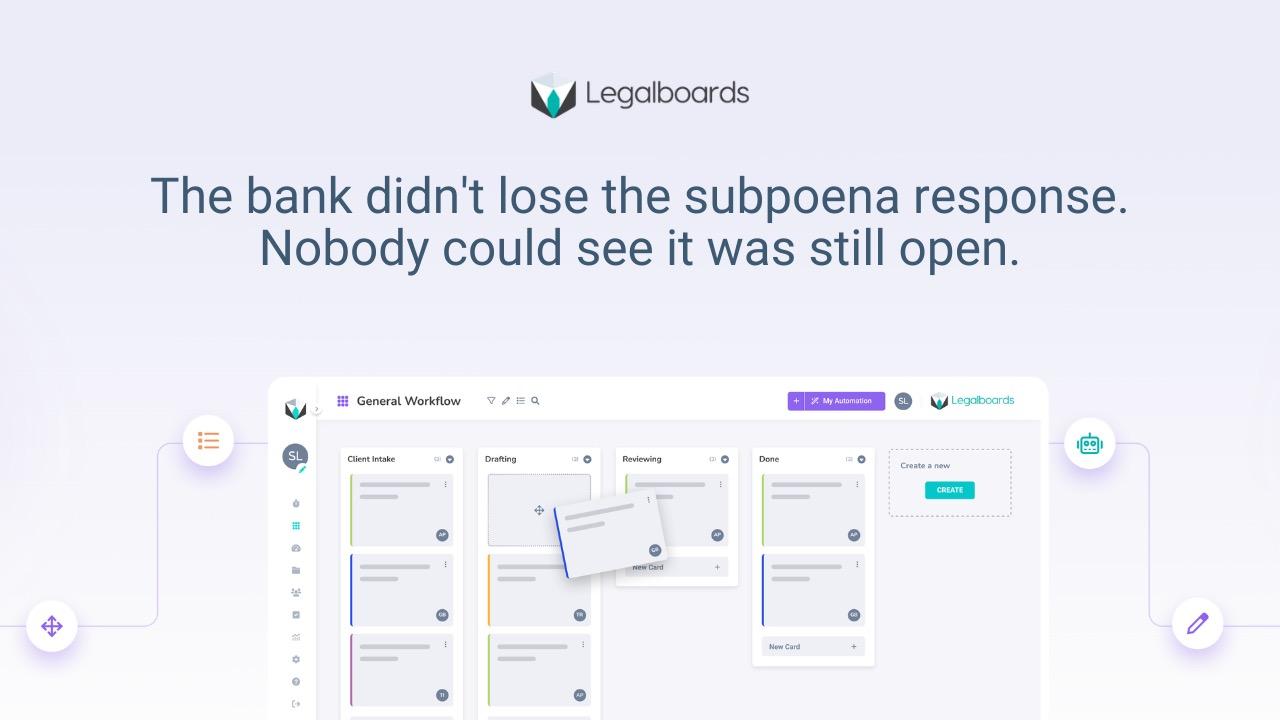
Legalboards does not compete with drafting tools. It gives AI-generated drafts a visible place to land as a task with an assigned reviewer and a deadline, so volume is distributed and tracked instead of silently piling up in one inbox.
If drafts are piling up waiting on the same reviewer, see how a visible review workflow addresses that → app.legalboards.io/register