
Most law firms track billable hours carefully. They rarely track where the non-billable hours go. Every status meeting, every follow-up email, every manual handoff between team members — that is time that consumed someone's day and appeared on no invoice. In a firm of 10 to 30 people, this coordination tax typically runs 10 to 15 hours per person per week.
Where non-billable time actually goes
Non-billable time is not one thing. It breaks into four categories, each with a rough weekly cost per person.
Status meetings: 2 to 4 hours per week. These exist because nobody knows where things stand without asking. A 30-minute check-in with two attorneys and a paralegal is 90 minutes of combined capacity — gone before anyone opens a document.
Follow-up emails and chasing: 3 to 5 hours per week. "Where are we on the Henderson motion?" "Did the client send those documents?" "Can someone confirm the filing went out?" Each one takes a few minutes to write, a few more to answer, and collectively they form a second job that nobody agreed to take on.
Manual task assignment and handoffs: 2 to 3 hours per week. Every time work crosses from one person to another and requires a human to initiate the transfer — an email, a message, a verbal reminder — that is coordination overhead. The work did not need a person to move it. The lack of structure did.
Re-explaining context to people picking up work: 1 to 2 hours per week. When someone picks up a matter mid-stream with no stage history, no ownership record, and no indication of what happened before, they spend time reconstructing context that should already be visible. That time is paid for by the firm and recovered by no one.
Add it up: 8 to 14 hours per person per week, conservatively. In most small law firms, that is the largest single category of untracked time — and it compounds directly with deadline tracking failures when the follow-up that did not happen was the one protecting a court date.
The difference between necessary overhead and avoidable waste
Not all non-billable work is a problem. Client intake, compliance reviews, firm administration, professional development — these are real costs that come with running a law firm. They are not the target.
The target is coordination overhead: time spent managing the movement of work that should move automatically. The follow-up email that exists because there is no automatic handoff. The status meeting that exists because there is no stage visibility. The re-explanation that exists because context is not recorded where work lives.
This category is almost entirely avoidable. It does not require cutting corners or asking people to work faster. It requires replacing manual coordination with structure.
Why most firms do not see this clearly
Time tracking in most law firms captures billable work. It does not capture the 20-minute email chain about where a draft is. It does not capture the partner who spent 45 minutes on calls before a client meeting just to confirm nothing had stalled. It does not capture the paralegal who answered the same status question four times on a Thursday afternoon.
The waste is invisible because nobody is measuring it. Operational visibility — seeing where work actually is across all active matters — is also what makes the cost of coordination overhead legible. Without it, the hours disappear into the day and partners are left with a vague sense that the firm should be more productive than it feels.
What the math looks like in a 15-person firm
Conservative assumptions: 10 hours per person per week of coordination overhead, 15 people, 50 working weeks per year. That is 7,500 hours annually consumed by coordination work that does not appear on any invoice.
At a blended billing rate of $150 per hour — modest for most US law firms — that is $1.1 million in annual capacity being spent on work that generates no revenue. Even if half of that time is genuinely unavoidable overhead, the recoverable portion is still in the hundreds of thousands of dollars per year.
For managing partners evaluating where operational investment makes sense, the math is straightforward: reducing coordination overhead does not require hiring, does not require training, and does not require changing how the legal work gets done. It requires changing how the work moves between people.
How workflow structure eliminates the avoidable overhead
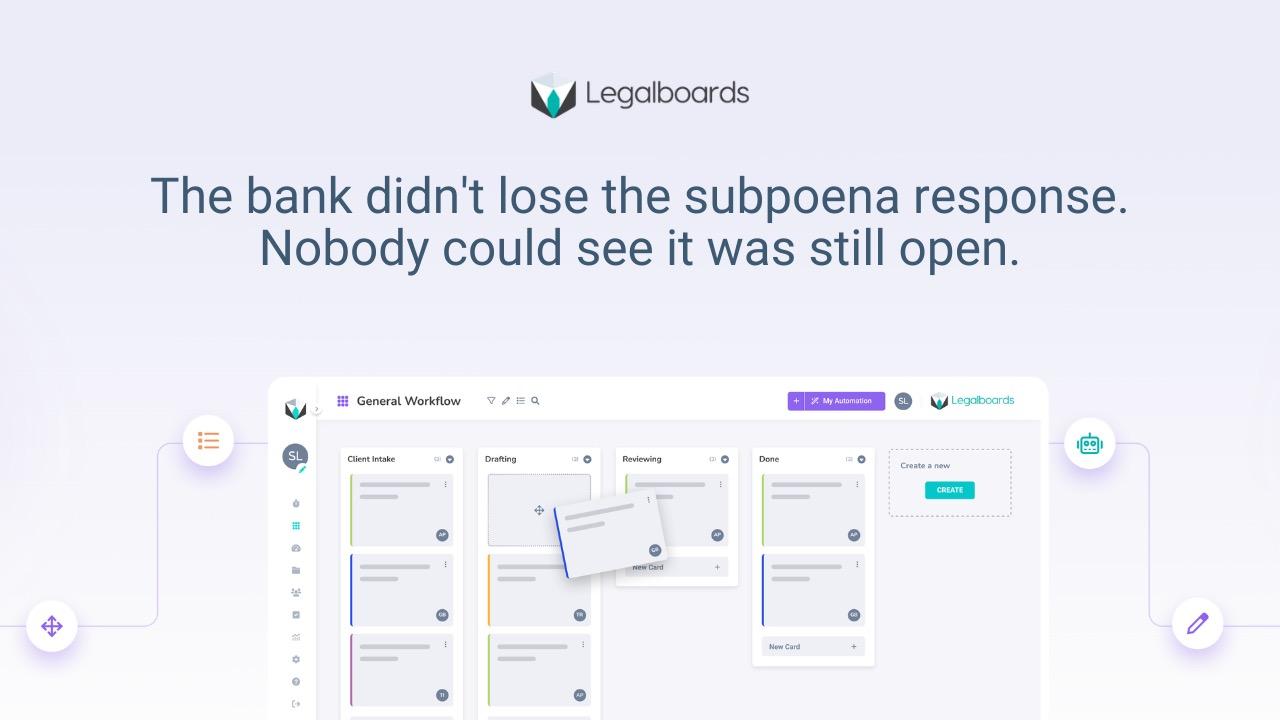
Automated handoffs eliminate the follow-up email. When a stage completes, the next owner is notified and the matter moves — no message required. Stage visibility eliminates the status meeting. When every active matter has a current position and a named owner, the question "where are we on this?" has an answer that does not require a meeting to produce.
Workflow automation does not ask people to change how they practice law. It changes how work transitions between steps — making the coordination that currently consumes hours happen automatically, in the background, without anyone managing it.
Where to start
The fastest way to see the impact is to map one workflow from intake to close. Pick your most common matter type. Write down every step. For each step, identify whether the transition to the next step requires a person to tell another person something. Every one of those hand-initiated transitions is an automation target.
Most firms find six to ten of these in a single matter type. Each one is a follow-up email that does not need to be written, a status question that does not need to be asked, a coordination cost that does not need to be paid.
If you want to see what the numbers look like for your firm specifically, the ROI calculator at Legalboards runs the estimate based on your team size and billing rate.
Frequently asked questions
How much non-billable coordination overhead is normal for a small law firm?
Most small firms carry 8 to 15 hours per person per week of coordination overhead — time spent on status management, manual handoffs, and follow-up that would not exist if work moved automatically. It tends to feel like "just how things work" until the structure changes and the hours reappear.
Does reducing non-billable hours mean asking people to work faster?
No. The goal is not speed — it is removing friction. When a paralegal no longer spends 30 minutes a day answering status questions, those 30 minutes are available for billable work. The pace of the legal work stays the same. The overhead around it shrinks.
How quickly does workflow automation show ROI in a law firm?
Most firms notice a reduction in follow-up volume and status meetings within the first two to four weeks of structured workflows running on active matters. The financial impact — recovered capacity showing up as additional billable hours — typically becomes measurable within the first quarter.
What is the first type of coordination overhead to automate?
Start with handoffs — the points where work moves from one person to another. These are the highest-frequency coordination events in most firms and the easiest to structure. Automating three or four handoffs in a single matter type removes more overhead than almost any other single change.
Will this work if only some of the team adopts it?
Partial adoption reduces but does not eliminate the benefit. The value of workflow structure compounds when the full team is using it — because the visibility and automatic handoffs only work if everyone is updating stages. That said, starting with one practice group or one matter type is a reasonable way to demonstrate the impact before firm-wide rollout.
If you are ready to map your firm's coordination overhead and see where structure would have the most impact, the workflow automation overview is the right starting point.