
Most law firm deadlines fail before the due date. The date is known. The calendar is set. But somewhere between assignment and filing, work stalls in someone's inbox, a handoff never happens, or a review sits waiting for days without anyone noticing. The deadline fails not because of the date — but because of what was invisible in the weeks before it.
The date is not the problem
Every firm has a calendar. Most firms have multiple — Outlook, Clio, a shared Google calendar, maybe a dedicated court rules tool. The date is never the surprise. What is invisible is the work that has to happen before the date, and whether it is actually moving.
Calendars mark the finish line. They do not tell you whether anyone has started running.
The three stages where deadline failures actually start
Deadline failures are not random. They cluster around the same three points in the workflow.
Stage 1: Drafting delays — work has not started and nobody knows. A motion is assigned. The paralegal has it on their list. But between the assignment and the first draft, three days pass silently. No one checks in because the deadline is still two weeks out. By the time anyone looks, the window for a proper review has shrunk to 48 hours. This is where how paralegals track deadlines becomes critical — the earliest stage is also the most invisible one.
Stage 2: Review bottlenecks — the draft is done but the reviewer does not know. The paralegal finishes the motion and sends an email. The attorney is in depositions. The email lands in a queue between billing reminders and a client message marked urgent. The draft sits for two days before the attorney opens it. Nobody missed a deadline yet — but the buffer is gone.
Stage 3: Handoff gaps — nobody owns the next step. Review is done. Revisions are made. Now the motion needs final formatting, exhibits attached, and filing confirmed. But there is no trigger. The paralegal does not know the attorney finished. The attorney assumes the paralegal is monitoring. The matter stalls in the gap between two people, and neither one is watching it.
These three stages repeat across matter types — motions, contracts, closings, client deliverables. The specifics change. The structure of the failure does not.
Why calendars create a false sense of security
A calendar entry for a filing deadline tells you one thing: the date. It does not tell you whether the motion was drafted. It does not tell you whether the review is stuck. It does not tell you whether the client returned the documents you requested ten days ago.
The calendar says "on time" right up until it does not. There is no yellow flag, no early warning, no signal that work is stalling. Operational visibility is not something a calendar provides — it requires knowing where work actually is, not just when it is due.
This is why firms that rely entirely on calendar-based deadline management get surprised. Not because the date changed, but because the work was never visible in the first place.
What deadline tracking through workflow actually looks like
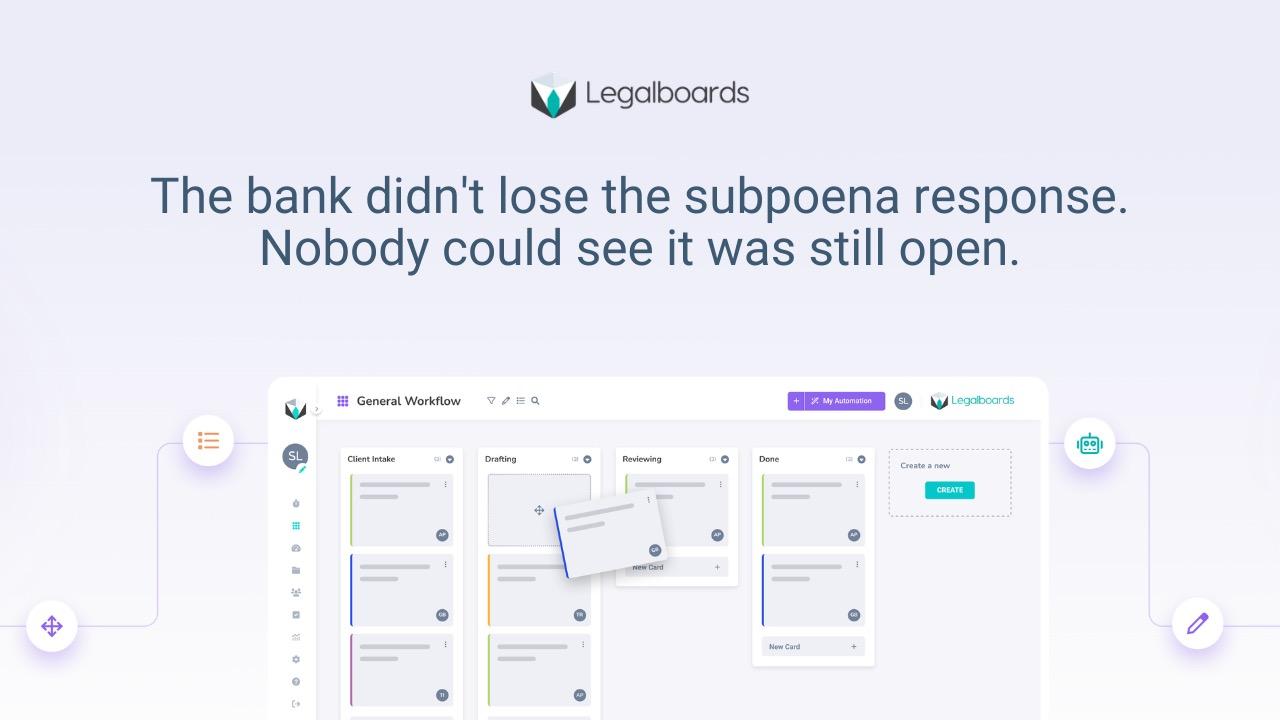
The alternative to calendar-only tracking is stage-based tracking — where every active matter has a named position in the workflow, every stage has an owner, and every stall surfaces automatically.
In practice this means: when a paralegal completes a draft, the matter moves to review and the assigned attorney is notified automatically. When review is done, the matter moves to filing and the paralegal picks it up — without anyone sending an email. If a matter sits at the same stage for more than a defined threshold, it gets flagged. The deadline tracking is built into the structure of how work moves, not bolted on after the fact as a calendar entry.
The deadline does not change. But the firm's ability to see whether it is actually safe — or silently at risk — changes entirely. Workflow automation turns that visibility into something that happens without anyone having to monitor it manually.
How to know if your firm has a deadline visibility problem
Answer these five questions honestly:
- When a matter is assigned, do you have a way to know whether work has actually started — without asking?
- When a draft is completed, does the reviewer find out automatically, or does the paralegal have to send a message?
- If a matter has been at the same stage for three days, does anyone get alerted?
- Can a partner look at active matters right now and see which ones are at risk — without calling anyone?
- In the last six months, has a deadline been closer than it should have been because a handoff was late or missed?
If you answered yes to three or more, the firm has a deadline visibility problem. Not a calendar problem, not a staffing problem — a structural problem with how work moves and whether its movement is visible.
The good news: this is fixable. It does not require hiring someone new or overhauling your case management system. It requires adding structure to how work flows between steps.
Frequently asked questions
What is the most common reason law firms miss deadlines?
The most common cause is not forgetting the date — it is that the work required before the date was invisible. A review stalled, a handoff was missed, or no one noticed the matter had not moved in days. By the time the deadline is visibly at risk, the buffer to fix it is already gone.
Is court rules software like LawToolBox enough to protect against missed deadlines?
Court rules tools are valuable for calculating deadline dates accurately. But they only solve the calendar problem. They do not tell you whether the draft was started, whether the review is stuck, or whether the filing is ready. You still need visibility into the work itself — not just the date.
How does workflow structure protect deadlines that a calendar cannot?
A structured workflow assigns ownership to every step and triggers the next step automatically when the prior one is complete. This means stalls surface before they become deadline risks. A calendar shows you the finish line. A structured workflow shows you whether you are on track to reach it.
What should I do when I realize a deadline is at risk?
First, identify exactly where the work is stalled — which step, and who owns it. Then assess whether the remaining steps can be compressed without cutting corners. The earlier you catch it, the more options you have. The goal is to build a system where you catch it early by default, not by accident.
Can a small firm track deadlines without expensive software?
Yes — up to a point. A shared spreadsheet with matter stages and owner assignments can work in a very small firm. The limitation is that it requires manual updates, and manual systems degrade under volume and pressure. Structured workflow tools handle the tracking automatically, which is where the real protection comes from.
If your firm is ready to move from calendar-based deadline management to something more structural, the deadline tracking overview covers what that looks like in practice and where to start.