
Lawyers work long hours. They carry high-stakes caseloads. They run businesses while practicing law at the same time.
Most articles about the challenges lawyers face list these realities and stop there, as if naming the pressure is the same as understanding it.
It isn't.
The firms that struggle most aren't struggling because their attorneys aren't capable. They're struggling because the work itself has no structure. Nobody can see what's moving, what's stalled, or what's about to become a problem — until it already is one.
That's a [workflow problem](/workflow-automation/). And it sits underneath almost every operational challenge a law firm faces.
1. Missed Deadlines — and the Real Reason They Happen
Missed deadlines are one of the leading causes of malpractice claims in North America. Most firms know this. Most firms have calendar tools, docketing systems, and reminders in place.
And deadlines still get missed.
The reason isn't that attorneys forget. It's that the work required before the deadline is invisible.
A court filing is due Friday. The attorney knows that. But does anyone know whether the supporting documents have been collected? Whether the draft has been reviewed? Whether the client signed off? Whether the paralegal waiting on a response is actually blocked?
When that chain of work isn't tracked, the deadline arrives without warning. [Deadlines fail because the work before them is invisible](/deadline-tracking/) — not because the date was unknown.
Malpractice insurance protects against the consequences. It doesn't prevent the breakdown.
2. The Hidden Cost of Coordination
Ask any paralegal or office manager at a small firm how much of their day goes to finding out where things stand.
The answer is usually more than anyone wants to admit.
Checking in with attorneys. Following up on documents. Asking whether a matter is ready for the next step. Sending the same reminder twice because the first one got buried.
This is [coordination overhead](/operational-visibility/) — and it compounds fast inside firms of 7 to 50 people. The firm doesn't have a workload problem. It has a workflow problem. Work is moving, but nobody can see it moving. So people spend time finding out what they could have seen at a glance.
Every hour spent on coordination is an hour not spent on billable work. It doesn't show up as a line item, but it shows up in your realization rate.
3. Taking on Work Without the Bandwidth to Handle It
Law firm growth creates a specific kind of pressure: the more successful you become, the harder it is to say no.
Profitable matters come in. The team looks busy but not overwhelmed. You take the work on. Then two months later, something slips.
Part of this is capacity judgment. But a bigger part of it is visibility. If you can't see how loaded your team already is — across all open matters, not just the loudest ones — you can't make a sound decision about taking on more.
The same applies to expanding into a new practice area. When the workflow for that area isn't documented and structured, the learning curve gets steeper. Work moves more slowly. Errors are more likely.
Firms that grow well are usually firms that have made their work visible before they scaled it.
4. Documentation Gaps That Create Exposure
Retainer agreements are a basic protection. Most attorneys know they need one. Most have also been in the situation where they assumed one wasn't necessary — because the client was a repeat client, or because the relationship felt solid, or because the initial call moved fast.
Then a misunderstanding develops. The scope of representation is disputed. Expectations weren't aligned because they weren't written down.
This isn't just a documentation problem. It's a process problem. When intake doesn't follow a consistent structure, things get missed. When onboarding steps aren't part of a visible workflow, they happen inconsistently — or not at all.
A [structured intake workflow](/workflow-automation/) doesn't just protect the firm legally. It protects the client relationship.
5. Non-Billable Time That Eats Into Firm Profitability
Non-billable time doesn't get as much attention as it should. Firms focus on utilization and realization rates, but they often don't trace where unrecoverable hours actually go.
A significant portion goes to status checks, repeated follow-ups, redoing work because context wasn't passed cleanly, and manually managing work that should move on its own.
Most of that is workflow failure. [Reducing non-billable hours at a law firm](/workflow-automation/) isn't primarily about working faster. It's about removing the friction that makes people spend time on overhead instead of work.
What Actually Fixes These Problems
There is no single tool that solves all of this. But there is a pattern in the firms that handle these challenges better than others.
They have made their work visible.
They know which matters are active and at what stage. They know where work is waiting. They know when something is overdue without having to ask. Their paralegals and office managers aren't spending half their day chasing status because the status is already visible.
That's [operational visibility](/operational-visibility/) — and it's the foundation that everything else is built on.
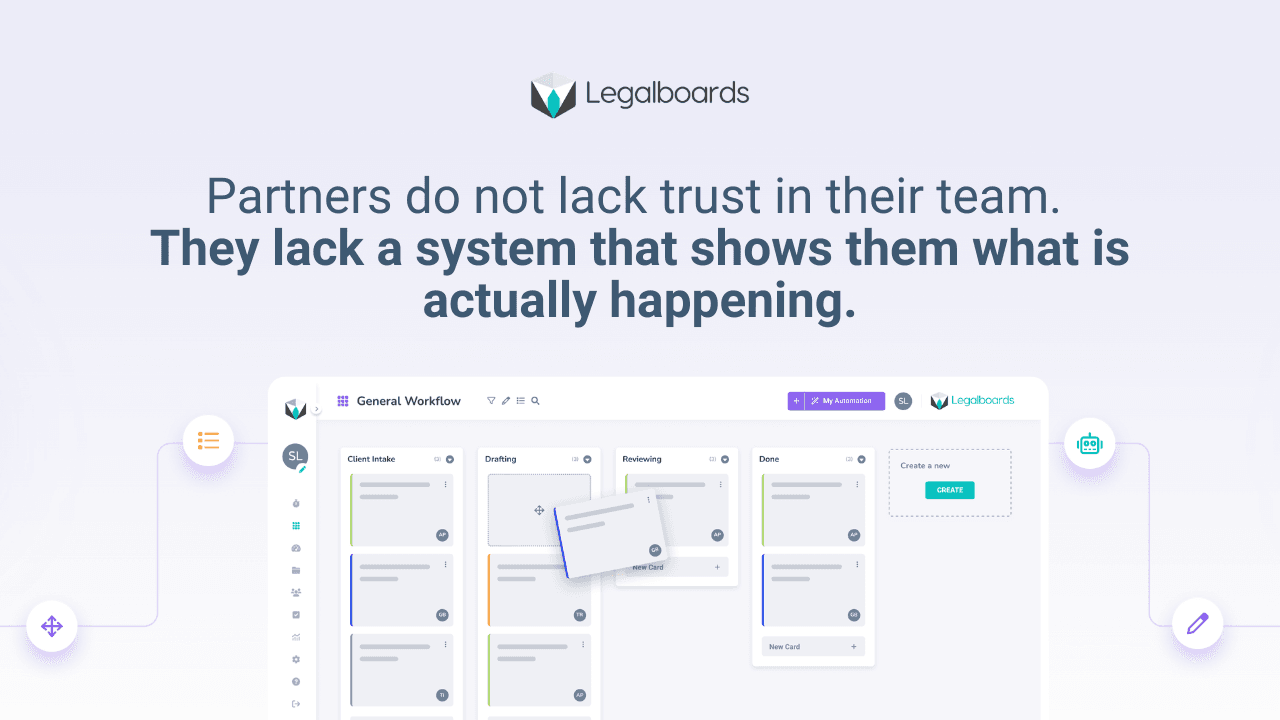
Legalboards is built specifically for small and mid-sized law firms — typically 7 to 50 people — who need to structure how work moves without adding administrative overhead. It gives your team [workflow visibility across every matter](/workflow-automation/), surfaces what's overdue before it becomes a problem, and removes the manual coordination that drives up non-billable time.
For [paralegals](/paralegals/) and office managers, it means fewer interruptions and clearer next steps. For partners, it means being able to see firm performance without calling a meeting to find out.
Frequently Asked Questions
What are the most common operational challenges law firms face?
Missed deadlines, rising non-billable time, poor visibility into matter status, and coordination overhead between attorneys and support staff. Most of these trace back to a lack of structured workflow.
Why do law firms miss deadlines even when they have calendars and docketing systems?
Because calendars track the deadline, not the work that has to happen before it. When that preparatory work isn't tracked or visible, the deadline can arrive without the necessary steps completed.
How can small law firms reduce non-billable hours?
By structuring how work moves between people. Most non-billable time goes to status checks, follow-ups, and manual coordination — all of which can be reduced when workflow is visible and automated where possible.
What is the difference between case management and workflow management for law firms?
Case management tools track matter information, documents, and contacts. Workflow management tracks how work moves through a matter — what needs to happen next, who owns it, and whether it's moving. Both are useful, but workflow management is what prevents coordination failures.
How does Legalboards help with the challenges lawyers face?
Legalboards structures [law firm workflows](/workflow-automation/) to give teams visibility across all active matters. It automates routine notifications, surfaces overdue tasks, and reduces the coordination overhead that drives up non-billable time.