Paralegal deadline tracking is not a calendar problem. It never was.
You already know when the deadlines are. The hearing is logged. The filing date is in Clio. The response deadline is in Outlook. That part is handled.
What is not handled is everything that has to happen before those dates. The document that has not arrived. The review sitting in an attorney’s inbox. The task assigned three weeks ago with no confirmation it was done. The client who has not responded. You know the deadline. You do not always know whether the work getting you there is actually moving.
That gap — between knowing a date and knowing the status of the work behind it — is where most deadline failures begin. And it falls on the paralegal to close it. Not because it is in the job description, but because someone has to.
This post is about how to build a system for paralegal deadline tracking that closes that gap with structure, not memory.
**The Real Problem Is Not the Deadline. It’s What’s Invisible Before It.**
Most firms treat deadline tracking as a calendar problem. Put the date in the system, set a reminder, done.
But calendars track dates. They do not track work. They do not tell you whether the medical records were requested, whether the draft was reviewed, whether the opposing party responded. A date is a fixed point. The work before it is a moving target, and in most small and mid-sized firms, that work is invisible to everyone except the person doing it.
This is why law firms miss deadlines even when all the dates are logged. The failure is not forgetting the date. The failure is not knowing the step before the date is not done.
For a paralegal managing one matter, this is manageable. For a paralegal managing twelve, fifteen, or twenty active matters simultaneously, paralegal deadline tracking becomes the entire job. Not the legal work. The tracking. The following up. The reconciling of information across email threads, case management systems, handwritten notes, and whatever the attorney mentioned in passing last Tuesday.
**Why Most Tracking Systems Break Down at Scale**
There are three patterns that show up in almost every firm where deadline tracking is struggling.
**1. Deadlines live in one place, work lives everywhere else**
The calendar has the hearing date. The tasks are in Clio. The document checklist is in a spreadsheet. The attorney’s comments are in an email. The client communication is in a separate thread. None of these systems talk to each other. The paralegal becomes the connective tissue — manually assembling the full picture of each matter from disconnected pieces, every single day.
This is what legal deadline management research consistently shows: tracking breaks down not because firms lack awareness of deadlines, but because the work between milestones is invisible. When a system cannot surface progress automatically, the paralegal has to supply that visibility manually.
**2. There is no cross-matter view**
You can open a matter and see what is happening with that case. But when you are managing fifteen matters, you cannot open fifteen tabs and mentally synthesize them all. You need a view of what is at risk across everything — right now, without opening each one individually.
Most case management systems are not built for this. They store information about individual matters. The cross-matter view — what is due this week, what is stuck, what is waiting on someone else — does not exist unless someone builds it manually, usually in a spreadsheet that is already out of date.
**3. Waiting is invisible**
This is the one that causes the most damage. Work that is waiting on someone else looks the same as work that has not started. A task sitting in a client’s inbox waiting for a response has no status in most systems. It is not due yet. It is not overdue. It just sits there, and the first sign of a problem is when the deadline is four days away and the document is still not there.
When you cannot see what is waiting, you cannot manage risk early. You can only react late. This is one of the core reasons deadline drift happens in law firms — not from a single missed date, but from invisible work piling up quietly across matters.
**What Structured Paralegal Deadline Tracking Actually Looks Like**
The shift is from tracking deadlines to tracking the work that supports them. A date on a calendar tells you when something is due. A workflow tells you whether you are going to make it.
Here is what structure looks like in practice when a paralegal is managing multiple matters at once:
**Each deadline connects to the steps before it**
Instead of a calendar entry that says “File motion — May 15,” a structured workflow includes every step that has to happen first: draft reviewed by attorney, client signature obtained, final edits completed, filing confirmed. Each step has a status. Each step has an owner. The deadline is the last row, not the only row.
This is the foundation of how law firm deadline tracking should work. The date is visible. The work behind it is equally visible.
**Someone owns each step — specifically**
“Someone will handle it” is not an owner. Ownership means one named person is responsible for moving that step forward. When a step stalls, it is immediately clear whose step it is. There is no ambiguity about who to follow up with, because the system already shows it.
This removes the cognitive load of mentally tracking who has what across every matter. You do not have to remember. The structure holds it.
**Status is visible without asking**
The goal of good paralegal deadline tracking is to know where every matter stands without sending an email or walking down the hall. If you need to ask someone for a status update, the system is not doing its job.
This is what operational visibility means at the matter level. Not a dashboard full of charts — just the ability to see at a glance what is moving, what is stuck, and what is at risk across your full caseload.
**Waiting gets its own status**
When a task is waiting on a client response or an external party, label it as waiting. Not open. Not incomplete. Waiting. This single distinction changes how you manage risk. You know it is not stalled on your end. You know when the waiting started. You know how long is reasonable before following up.
Most firms do not track waiting as a distinct status. That is where invisible risk quietly accumulates.
**The Compounding Problem: What Happens When One Matter Slips**
When you are managing one case, a small slip is manageable. When you are managing many, a slip in one creates a cascade.
The attorney review that ran long on Matter A pushed your afternoon. Matter B’s follow-up email did not get sent. That client’s document did not arrive. Now Matter B’s deadline, which was fine yesterday, is suddenly at risk. And you will not know until you open it.
This is why cross-matter visibility matters as much as individual matter visibility. The question is not just “is this matter on track?” It is “given everything on my plate right now, what is most at risk this week?”
That is a workflow question, not a calendar question. And paralegal deadline tracking at scale requires a system designed to answer it.
**How Legalboards Supports Paralegal Deadline Tracking**
Legalboards is built around exactly this problem. It sits on top of your existing case management system — Clio, MyCase, PracticePanther — and adds the workflow layer that makes deadline tracking actually work.
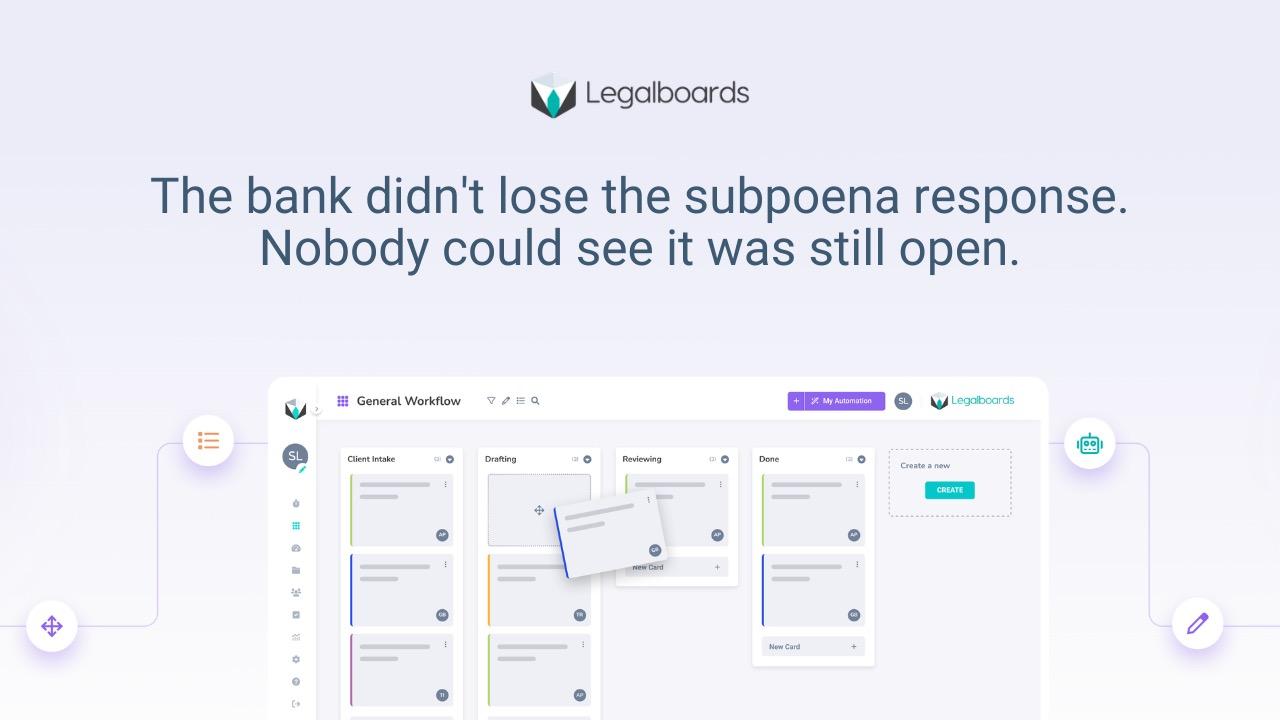
Each matter is a visual board with defined stages. Each stage has tasks with owners and due dates. When a task completes, the next one triggers automatically. When something is waiting, it is labeled as waiting. When a deadline is approaching and a prior step is incomplete, that is visible to everyone without anyone having to check in.
The automation layer replaces the follow-up work that currently lives in your head. When a card moves to a new stage, tasks are created, assigned, and dated automatically. No manual setup every time a matter progresses. No emails to remind someone the ball is in their court.
The result is a paralegal who spends less time tracking and more time doing. And a firm where deadlines are protected by the system, not by whoever happens to remember.
**What to Do Right Now If Your System Is Built on Memory**
You do not have to overhaul everything at once. Start with the highest-risk matters and apply structure there first.
- Map the steps before each major deadline — not just the date itself
- Assign a named owner to every step, not a team, a specific person
- Add a waiting status for anything dependent on a client or external party
- Build a weekly habit of reviewing the cross-matter view: what is due, what is stuck, what is waiting
- Document the pattern so it is repeatable and not just in your head
If you are doing this manually right now, you already understand the value of structure. The question is whether your tools support it or make it harder.
Most case management software was built to store legal work, not to manage how it moves. That is the gap law firm workflow management is designed to close. Paralegal deadline tracking works when it is built into the workflow, not bolted onto a calendar.
**Frequently Asked Questions**
**What is paralegal deadline tracking and why does it fail in most firms?**
Paralegal deadline tracking is the practice of monitoring not just deadline dates but the work steps leading up to each one. It fails in most firms because the calendar only records the date, while the actual work — tasks, documents, reviews, approvals — lives across disconnected systems. When those steps are invisible, deadline risk is invisible too.
**Why do paralegals miss deadlines even when all the dates are in the calendar?**
Because the calendar tracks the date, not the work. A deadline fails when a step before it is missed — a document that did not arrive, a review that did not happen, a task nobody knew was theirs. Structured paralegal deadline tracking surfaces those gaps before they become failures.
**What tools help paralegals manage deadlines across multiple cases?**
The most effective approach combines your existing case management system (Clio, MyCase, PracticePanther) with a workflow layer that makes matter progress visible across all cases at once. Legalboards sits on top of case management to add visual workflow boards, task ownership, and automated step triggers — so paralegal deadline tracking does not depend on manual follow-up.
**How do I track deadlines when work is waiting on a client or third party?**
Create a distinct waiting status separate from open or incomplete. Record when the wait started and set a follow-up trigger. Most systems skip this, which is why waiting work becomes invisible and creates deadline risk nobody sees until it is too late.
**How many cases can a paralegal manage with proper deadline tracking in place?**
There is no fixed number — it depends on case complexity and firm size. But paralegals with structured workflow tracking consistently manage more matters with less cognitive load than those relying on memory and informal systems. The limit shifts from how much you can hold in your head to how much the system supports.
**Ready to Stop Tracking Deadlines From Memory?**
Legalboards gives paralegals a visual workflow layer on top of the case management system you already use. Every matter, every step, every owner — visible without asking.
Start a free 7-day trial at app.legalboards.io — no credit card required.