
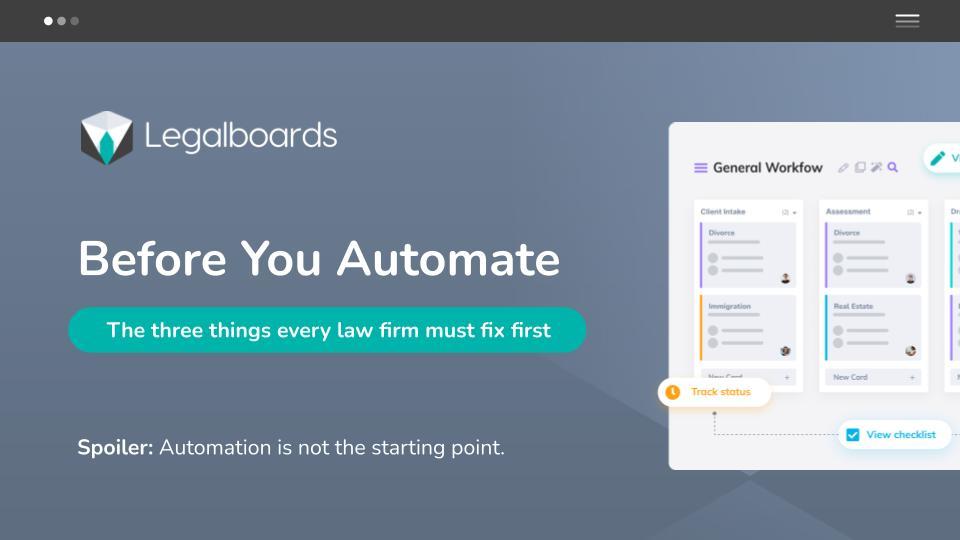
If you want to prepare a law firm for automation, you must fix your workflows first.
Automation does not fix broken processes. It scales them.
Many small and mid-sized law firms jump into automation because their teams feel overwhelmed. Paralegals are chasing deadlines. Office managers are firefighting. Partners lack visibility across cases.
But without structure, automation creates faster confusion instead of clarity.
In this webinar, we explain exactly how to prepare a law firm for automation the right way.
What You Must Fix Before Automating
In the webinar, we walk through the core structural gaps that block automation success:
1. Undefined Case Stages
If you cannot clearly define the stages of a matter, automation has nothing to trigger from.
2. No Clear Task Ownership
If everyone is “kind of responsible,” no one is accountable. Automation depends on explicit ownership.
3. Scattered Information
When tasks live in email, spreadsheets, and different systems, automation becomes unreliable.
4. Lack of Visibility
If partners cannot see where cases are stuck or which matters are delayed, automation alone will not solve that.
5. No Operational Standardization
If your firm does not follow consistent workflows, no tool will magically create discipline.
Automation works only when structure exists first.
Watch the Full Webinar Replay
In this session, you will learn:
- The 5 structural mistakes that make automation fail
- How to map your legal workflows properly
- What small firms should standardize before adding automation
- When automation actually creates leverage instead of complexity
Download the Workflow Preparation Kit
To help you apply what we cover in the webinar, we created a practical preparation kit.
Inside the kit:
- Workflow mapping template
- Task ownership checklist
- Case stage definition worksheet
- Automation readiness assessment
When Structure Is Clear, Automation Becomes Powerful
Once workflows are defined and responsibilities are clear, automation can:
- Reduce manual follow-ups
- Improve case visibility
- Decrease deadline anxiety
- Recover significant non billable time
But only after the foundation is solid.
If you want to see how structured workflows and automation work together in practice:
Explore Legalboards → https://legalboards.com
See how workflows are structured
For broader context on legal operations trends, the Legal Executive Institute provides industry research