Most firms are adding AI tools without asking a harder question first.
Who owns the work those tools are supposed to support?
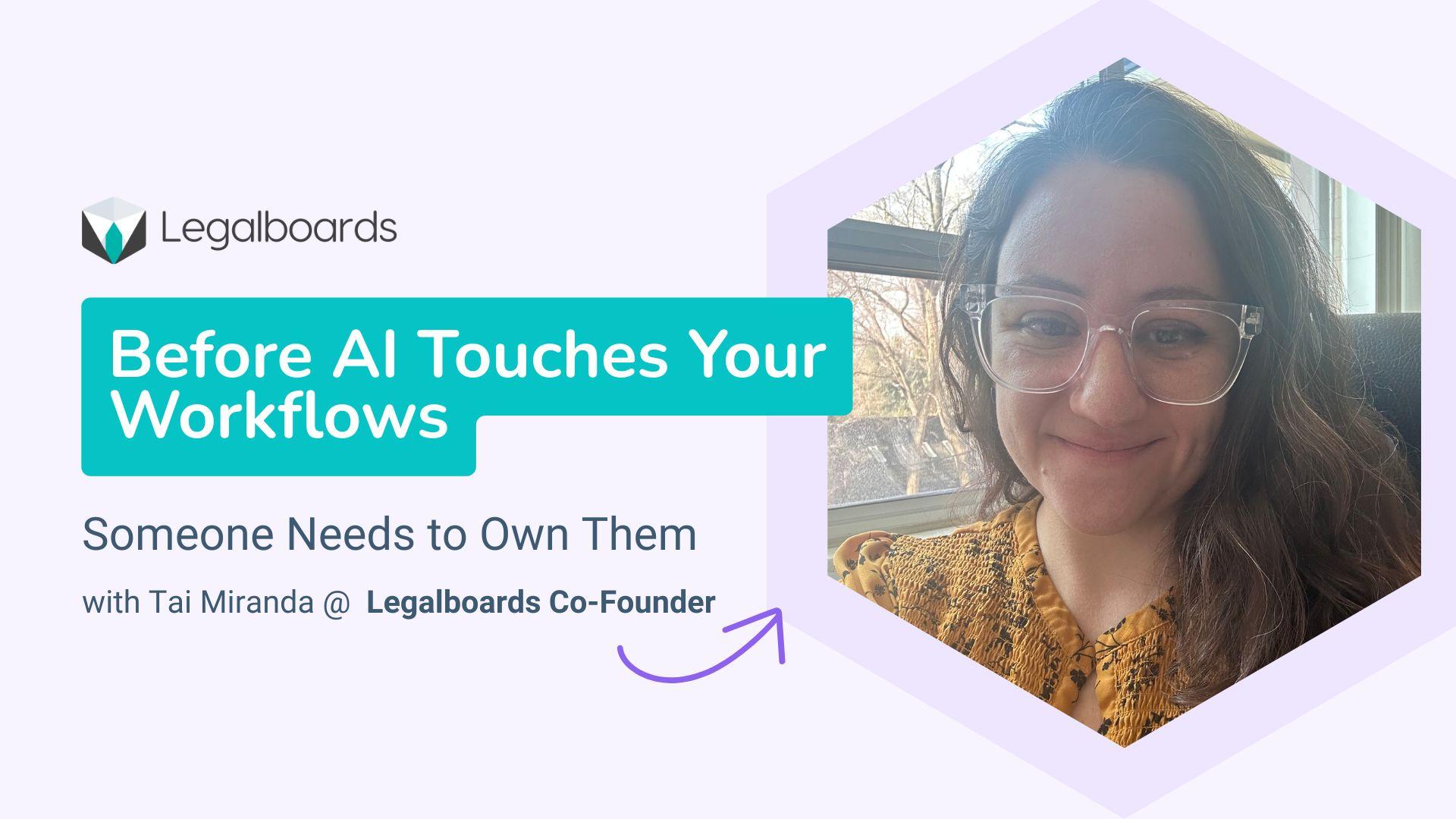
That was the focus of this Legalboards Academy session. Not AI features or product demos. The operational reality that sits underneath all of it: if your workflows are unclear, unowned, or invisible, AI does not fix that. It makes it harder to see.
What This Session Was About
The framing we started with: AI outputs at the level of the person prompting it.
That sounds like a statement about skills. It is also a statement about structure.
When a junior team member uses AI to draft a document, summarize a matter, or generate a checklist, the output reflects the context they gave it. If the context is incomplete, if ownership is unclear, if the workflow has no defined stages, the output sounds polished but misses things. And because it sounds polished, it can go uncaught.
That is the risk most firms are not talking about.
This session covered three things:
- Why workflow ownership is the prerequisite AI adoption is missing
- What it means to own AI context, not just AI tasks
- How to map ownership before the tools go in
The Problem With How Firms Are Adopting AI
The default approach is to add the tool first and figure out ownership later.
Someone on the team gets access. They start using it. It looks like it is working. But there is no structure behind it. No defined stages, no clear handoffs, no accountability for what the AI is generating and what happens to it.
The gap is not between firms that have AI and firms that do not. The gap is between firms where someone owns the workflow AI is operating inside of, and firms where no one does.
Without that ownership, you are not automating a process. You are automating improvisation.
Why Ownership Is the Actual Problem
Law firm workflows break at handoffs, not inside individual tasks. That is true whether AI is involved or not.
When AI enters an unstructured environment, it speeds up the work but not the coordination around it. Documents get drafted faster. Questions get answered faster. But if nobody owns the stage that work sits in, if nobody is accountable for moving it forward, speed does not help. Things still stall. Deadlines still get missed. Partners still get surprised.
Operational visibility is what tells you whether work is actually moving, not just whether tasks are being completed. AI does not create that visibility. Structured, owned workflows do.
This session introduced a framework for thinking about ownership across three layers:
- Task ownership — who is responsible for completing a specific action
- Stage ownership — who is accountable for everything in a given workflow stage
- Context ownership — who is responsible for the information and framing that feeds into AI-generated outputs
Most firms think about the first layer. Some think about the second. Almost no one has defined the third.
AI Outputs at the Level of the Person Prompting It
This is the insight that matters most.
If a paralegal prompts an AI tool with partial case information, the output will reflect that. If an associate prompts it without knowing the full intake context, the output will reflect that too. The AI does not know what it does not know. It produces something that looks complete.
That is where the risk lives: not in obviously wrong outputs, but in plausible-sounding ones built on incomplete context.
The firms that use AI well are not necessarily the ones with the most sophisticated tools. They are the ones where people know what they own, know what information they are responsible for, and can give the AI the right context because the workflow tells them what that is.
Workflow automation works the same way. Automation at the stage level, with clear ownership, produces reliable results. Automation layered on top of unclear handoffs produces reliable-looking results that still fail when it matters.
The AI Ownership and Context Map
The downloadable resource from this session is a structured worksheet for mapping AI ownership across your firm's workflows.
It is modeled on a RACCI-style format: who is Responsible, who is Accountable, who needs to be Consulted, who needs to be Informed, and critically, who owns the Context that feeds into any AI-generated work at each stage.
The Context column is what makes this different from a standard RACI. It forces the question: before anyone uses AI on this step, who is responsible for making sure the input is complete and accurate?
Download the AI Ownership and Context Map and all session resources here.
What This Means for Paralegals
Why paralegals are left holding the risk when AI enters an unstructured workflow is a pattern that comes up often in this work.
The situation goes like this: AI tools get introduced. Partners and associates start using them for drafting, research, and summaries. The outputs filter through the firm. Paralegals are often the ones who catch inconsistencies, spot what is missing, or flag that something does not line up with what they know about the matter.
That is not the AI being useful. That is the AI distributing risk to the person closest to the detail.
When ownership is clear, that dynamic changes. Paralegals know what context they own. They can provide it deliberately instead of cleaning up after outputs that were generated without it.
Where to Start
The question at the end of the session was a practical one: before your firm adds another AI tool, can you answer these three questions?
- Who owns each stage of the workflows that AI will touch?
- What information needs to be present at each stage for AI outputs to be reliable?
- Who is accountable when an AI-generated output is incomplete or wrong?
If you cannot answer those, the tool is not the starting point. The workflow is.
Legalboards helps firms define that structure. Clear stages, named ownership, and the visibility to see where work actually sits, before and after automation touches it.
Download the session resources or book a session to see how this applies to your firm's workflows.