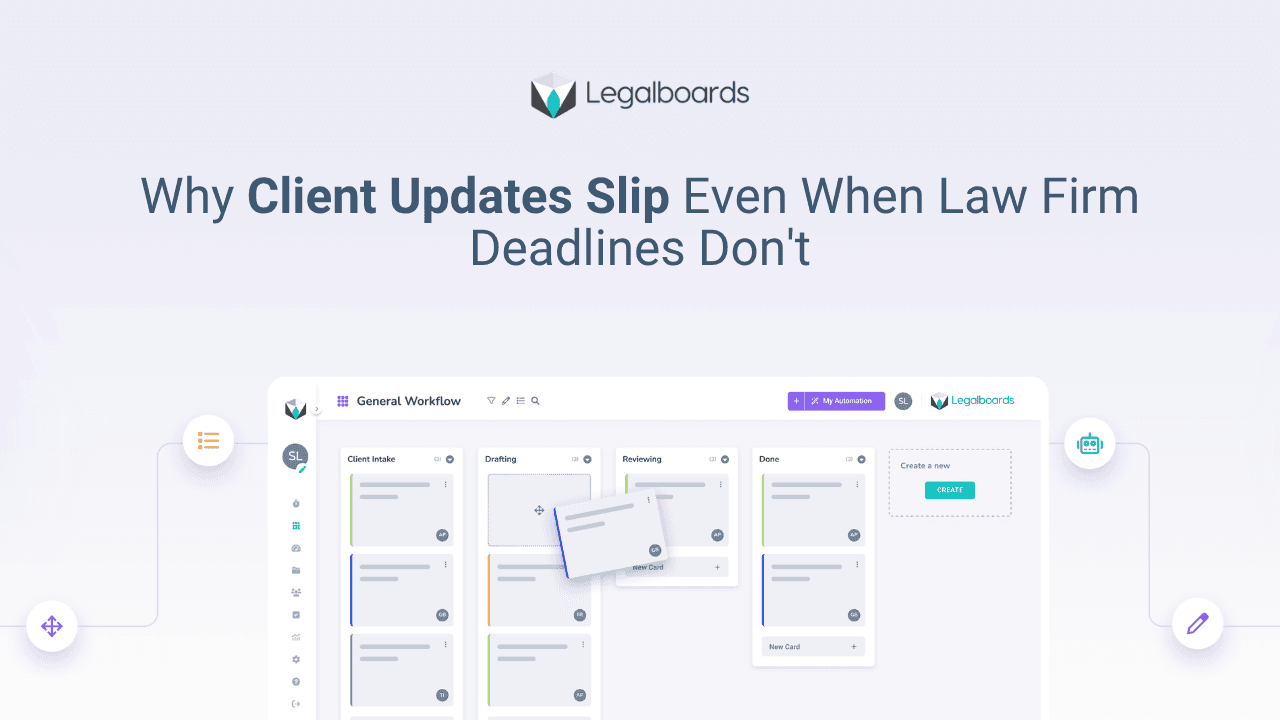
Why Client Updates Slip Even When Law Firm Deadlines Don't
A filing goes out on time. The court date is met. This is the exact gap a law firm client communication workflow is supposed to close, and most firms do not have one, even when their deadline tracking is solid. The client still calls the office annoyed, because nobody told her anything happened for three weeks.
Why Do Client Updates Slip Even When Deadlines Are Met?
A working law firm client communication workflow is what closes this gap, and most firms only build half of it. Client updates slip because meeting a deadline and communicating about a deadline are two different tasks, and most firms only build a system for the first one. The filing gets done because a court date forces it. The update to the client does not have a forcing function, so it depends on someone remembering to send it.
A communication rhythm is a scheduled, predictable cadence of updates, client-facing and internal, that runs independently of whether anything dramatic has happened on a matter. Without one, clients only hear from the firm when there is news, which can mean silence for weeks at a stretch.
This is a distinct problem from missing a deadline outright, which is the focus of most deadline tracking tools. A firm can hit every court date and still leave a client feeling ignored, because the deadline system tracks the work, not the conversation about the work.
Where Communication Gaps Actually Happen
Here is a concrete version of the gap. A personal injury matter is in the discovery phase for six weeks. Nothing client-facing happens during that stretch: depositions are scheduled, documents are exchanged, motions are drafted. From the client's side, it looks like nothing is happening at all, because nobody scheduled a check-in independent of case milestones.
The client calls. The paralegal spends twenty minutes explaining that everything is on track, which it was the entire time. That call was not necessary work. It existed only because there was no standing update the client could expect without asking.
The same gap happens internally. A partner assumes an associate is handling a follow-up. The associate assumes it already went out. Neither checks, because there is no shared, visible record of the last time anyone touched the file. Law firm coordination problems like this rarely show up as a missed deadline. They show up as a client who feels forgotten and a team that cannot say, without checking three inboxes, when they last spoke to her.
Firms that fix this build a rhythm that runs on a schedule, not on news. A biweekly update, sent whether or not anything changed, closes the gap that milestone-only communication leaves open. That rhythm, more than any single tool, is what a real law firm client communication workflow looks like day to day.
More on how these gaps compound across a caseload is covered in why law firm deadlines fail, which looks at the tracking side of the same underlying problem.
How Legalboards Keeps Updates Moving Without Extra Meetings
Fixing this does not mean adding a status meeting to everyone's calendar. It means making the last-touched date and next scheduled update visible without anyone having to ask.
With Legalboards, a matter sitting in a stage for longer than its expected window surfaces automatically, so an office manager can see which cases have gone quiet before a client calls to ask. Clio holds the matter record and the documents. Legalboards shows whether that matter has had a client-facing touchpoint recently, and flags it when it has not. One firm profiled in Strauss Attorneys' workflow precision case study described this shift as the difference between reacting to a client's frustration and catching the gap before the client noticed it.
This does not require a new communication policy nobody follows. It requires the aging status becoming visible to the people already responsible for the matter, at the moment it starts to age, not weeks later.
What Silent Cases Cost the Firm
A 2023 industry survey from the American Bar Association found that poor communication remains one of the top drivers of client dissatisfaction and bar complaints against attorneys, ahead of case outcome in many instances. Clients rarely leave firms because a case went badly. They leave, or complain, because they felt uninformed.
The internal cost is just as real. Every unscheduled "just checking in" call is unbilled time spent managing a perception problem that a standing update cadence would have prevented. A paralegal fielding three status calls a week is not doing case work during those calls. She is doing damage control for a gap the firm's systems should have caught first.
Case stage aging refers to how long a matter has sat in its current stage without a client-facing update or an internal status check. Tracking this number, even loosely, tells a firm where its next uncomfortable client call is coming from before it happens.
Frequently asked questions
How often should a law firm update clients on their case?
Many firms aim for a standing update every two to three weeks regardless of whether anything major has changed, in addition to updates tied to real milestones. Consistency matters more than frequency, because clients calibrate their expectations to what actually happens, not to a stated policy.
Why do clients complain even when their case is on track?
Clients usually complain about silence, not delay. If a matter has real progress but no visible communication, a client has no way to distinguish "on track and quiet" from "stalled and ignored."
What is a communication rhythm in a law firm workflow?
A communication rhythm is a scheduled cadence of client and internal updates that runs independently of case milestones. It ensures clients hear from the firm on a predictable schedule, not only when something dramatic happens.
Does better communication mean more meetings for paralegals?
Not necessarily. The goal is visibility into which matters have gone quiet, so updates can be sent efficiently, often in a few minutes, rather than adding recurring meetings that consume time whether or not any matter actually needs discussion.
How can I tell if my firm has a client communication gap?
If a client's call about status catches the team off guard, that is usually a sign the update should have gone out before the client had to ask. A healthy communication workflow makes "we were about to update you" true in practice, not just in theory.
Does Legalboards handle client communication for us?
No. Legalboards does not send client-facing messages on the firm's behalf. It surfaces which matters have gone quiet longer than expected, so the person responsible for that matter knows to reach out before the client does.
What is the difference between deadline tracking and communication tracking?
Deadline tracking monitors when work must be filed or completed. Communication tracking monitors when a client or internal team last received an update, independent of whether a deadline is approaching. A firm needs both, because meeting deadlines does not guarantee anyone told the client about it.
If your firm cannot say which matters have gone quiet this week, see how case status stays visible in Legalboards → app.legalboards.io/register
Ready to streamline your firm's workflow? Try Legalboards for free and keep every case moving forward.